Key Highlights
- AI is transforming healthcare beyond chatbots.
- Clinical and operational AI solve real hospital challenges.
- AI improves diagnostic speed and accuracy.
- Predictive analytics enables earlier interventions.
- Workflow automation reduces administrative burden.
- AI streamlines medical coding and billing.
- Personalized treatment improves patient outcomes.
- AI accelerates drug discovery and research.
- AI optimizes hospital resources and bed management.
- A strong AI readiness strategy is essential for success.
Artificial intelligence is no longer limited to answering patient questions through chatbots or virtual assistants. Today, AI in healthcare is helping hospitals diagnose diseases earlier, automate repetitive administrative tasks, improve clinical decisions, and optimize hospital operations.
Healthcare organizations worldwide face increasing patient volumes, staff shortages, rising operational costs, and growing demands for better patient experiences. AI provides practical solutions to these challenges by enhancing both clinical care and administrative efficiency.
However, successful AI adoption is not about replacing healthcare professionals. Instead, it empowers doctors, nurses, administrators, and hospital leaders with better insights, faster decision-making, and smarter workflows.
This guide from Webtree Software Solutions explores ten real-world AI applications that are transforming healthcare beyond chatbots while explaining how hospitals can prepare for successful AI implementation.
Why AI in Healthcare Is About More Than Chatbots
When many people hear the term AI, they immediately think about chatbots answering patient queries or booking appointments. While conversational AI certainly has value, it represents only a small portion of what artificial intelligence in healthcare can accomplish.
Healthcare AI generally falls into four major categories:
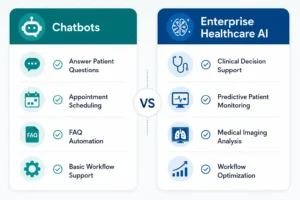
Enterprise healthcare AI focuses on solving complex operational and clinical problems rather than simply interacting with patients.
Healthcare organizations are increasingly investing in AI because it helps them:
- Improve diagnostic accuracy
- Reduce administrative workload
- Increase operational efficiency
- Enhance patient outcomes
- Optimize resource utilization
- Lower healthcare costs
Instead of viewing AI as another software tool, healthcare leaders should see it as a strategic capability that supports better business and clinical outcomes.
Choosing the right platform is equally important for long-term success. Read our guide on Hospital Management Software vs ERP to understand which solution best fits your healthcare organization’s operational and administrative needs.
Where AI Creates the Greatest Value in Healthcare
Rather than thinking about AI by technology, hospitals should evaluate where it delivers measurable business value.
AI applications extend across nearly every department.
| Healthcare Function | AI Opportunity |
|---|
| Clinical Care | Decision support and treatment recommendations |
| Diagnostics | Medical imaging and disease detection |
| Administration | Billing, coding, scheduling |
| Operations | Resource planning and workflow optimization |
| Patient Engagement | Personalized communication |
| Research | Drug discovery and clinical trials |
| Compliance | Documentation and risk monitoring |
This functional approach helps healthcare organizations identify projects that generate the highest return on investment while improving patient care.
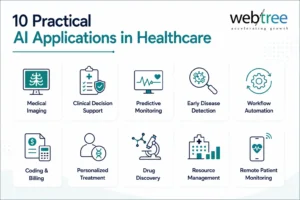
10 Practical AI Use Cases Transforming Healthcare
1. AI-Assisted Medical Imaging
The Challenge
Radiologists often review hundreds of medical images daily, increasing workload and the possibility of delayed diagnosis.
AI Solution
AI algorithms rapidly analyze X-rays, CT scans, MRIs, and mammograms to identify abnormalities that require further review.
Business Benefit
- Faster diagnosis
- Improved accuracy
- Reduced reporting time
Example
AI can highlight suspicious lung nodules in chest CT scans, helping radiologists prioritize high-risk cases.
According to Deloitte’s 2025 Global Health Care Outlook, many health systems are moving beyond pilot projects by integrating AI, machine learning, predictive analytics, and cloud technologies to improve administrative, financial, and clinical efficiency. The report also notes that over 40% of surveyed health systems have already experienced moderate to significant returns from their generative AI investments, highlighting AI’s growing role in healthcare transformation.
2. Clinical Decision Support Systems
The Challenge
Clinicians must interpret enormous volumes of patient information while making time-sensitive decisions.
AI Solution
Clinical AI analyzes patient history, laboratory results, medications, and treatment guidelines to provide evidence-based recommendations.
Business Benefit
- Better treatment decisions
- Reduced medical errors
- Improved patient safety
Example
AI can alert physicians about potential drug interactions before prescriptions are finalized.
3. Predictive Patient Monitoring
The Challenge
Hospitalized patients may deteriorate unexpectedly between routine assessments.
AI Solution
Predictive analytics continuously monitors vital signs and identifies subtle changes that indicate clinical deterioration.
Business Benefit
- Earlier intervention
- Reduced ICU admissions
- Lower mortality rates
Example
AI systems can detect early signs of sepsis hours before traditional methods.
4. Early Disease Detection
The Challenge
Many diseases are diagnosed only after symptoms become severe.
AI Solution
Machine learning models identify hidden patterns in patient data to detect diseases at earlier stages.
Business Benefit
- Earlier treatment
- Better patient outcomes
- Lower treatment costs
Example
AI is increasingly supporting early detection of cancers, diabetic retinopathy, and cardiovascular diseases.
5. AI for Hospital Workflow Automation
The Challenge
Healthcare professionals spend significant time completing repetitive administrative work.
AI Solution
AI automates documentation, appointment scheduling, patient registration, referrals, and workflow coordination.
Business Benefit
- Reduced administrative burden
- Faster patient processing
- Higher staff productivity
Example
Hospitals can automate patient intake forms and appointment reminders, reducing manual effort for administrative teams.
AI-powered automation delivers the greatest value when it addresses existing operational bottlenecks. Explore the common hospital workflow challenges and practical solutions to understand how hospitals can improve efficiency, reduce administrative burden, and enhance patient care.
6. Medical Coding and Billing Automation
The Challenge
Manual coding increases billing errors, delays reimbursements, and impacts revenue.
AI Solution
Natural language processing extracts clinical information and recommends appropriate medical codes automatically.
Business Benefit
- Faster claims processing
- Improved coding accuracy
- Reduced revenue leakage
Example
AI can review physician notes and suggest ICD and CPT codes before submission.
7. Personalized Treatment Recommendations
The Challenge
Patients often respond differently to identical treatment plans.
AI Solution
AI evaluates medical history, genetics, lifestyle factors, and clinical evidence to recommend personalized treatment options.
Business Benefit
- Better treatment effectiveness
- Improved patient satisfaction
- More personalized care
Example
Oncology teams can use AI to recommend therapies based on tumor characteristics.
8. Drug Discovery and Clinical Research
The Challenge
Developing new medicines is expensive and time consuming.
AI Solution
AI analyzes molecular structures, predicts drug interactions, and identifies promising drug candidates faster.
Business Benefit
- Shorter research cycles
- Lower development costs
- Faster innovation
Example
Pharmaceutical companies use AI to screen millions of compounds before laboratory testing begins.
9. Hospital Resource and Bed Management
The Challenge
Poor resource allocation leads to overcrowding, delayed admissions, and inefficient bed utilization.
AI Solution
AI predicts patient admissions, discharge patterns, and resource requirements.
Business Benefit
- Better bed utilization
- Reduced waiting times
- Improved operational efficiency
Example
Hospitals can forecast ICU occupancy and allocate staff proactively.
10. Remote Patient Monitoring
The Challenge
Managing patients with chronic conditions outside the hospital is difficult.
AI Solution
Connected medical devices continuously monitor patients at home while AI identifies abnormal trends.
Business Benefit
- Fewer hospital readmissions
- Continuous patient care
- Better chronic disease management
Example
AI can monitor heart failure patients remotely and notify clinicians when intervention is needed.
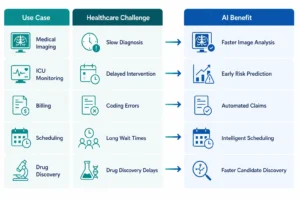
AI Applications Across Healthcare
As healthcare organizations invest in AI, one of the key decisions is whether to build a custom AI-enabled healthcare platform or adopt an existing solution. Read our guide on building vs buying healthcare software to evaluate the best approach based on your goals, budget, and long-term scalability.
What Hospitals Need Before Implementing AI
Successful AI adoption begins with preparation rather than technology selection.
Hospitals should assess several readiness factors before implementation.
AI Readiness Checklist
- Digital patient records
- High-quality healthcare data
- Electronic Health Record (EHR) integration
- Secure cloud infrastructure
- Leadership commitment
- Staff training
- Governance policies
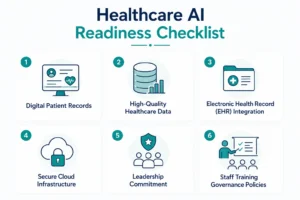
Organizations with strong digital foundations typically achieve faster AI adoption and better long-term results.
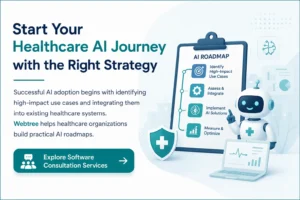
Successfully implementing AI requires more than selecting the right technology. Hospitals need a structured approach to assess digital maturity, prioritize initiatives, and integrate AI into existing clinical and operational systems. Explore our Healthcare Digital Transformation Roadmap to learn how to build a successful digital transformation strategy.
Challenges and Ethical Considerations
While AI offers significant benefits, responsible implementation is essential.
| Challenge | Best Practice |
|---|
| Patient Privacy | Encryption and secure data storage |
| AI Bias | Continuous model validation |
| Regulatory Compliance | Role-based access controls |
| Staff Resistance | Training and change management |
| Poor Data Quality | Strong data governance |
| Integration Complexity | Phased implementation strategy |
Healthcare AI should always complement clinicians rather than replace their expertise. Human oversight remains critical for ensuring safe and ethical patient care.
How to Prioritize AI Projects in Healthcare
Many hospitals struggle because they attempt to implement too many AI initiatives simultaneously.
A structured prioritization framework helps organizations invest where the greatest value exists.
Evaluate projects using:
- Patient impact
- Operational improvement
- Cost savings
- Ease of implementation
- Data availability
- Expected ROI timeline
| AI Initiative | Business Impact | Complexity | Priority |
|---|
| Billing Automation | High | Low | High |
| AI Radiology | High | Medium | High |
| ICU Monitoring | Very High | High | High |
| Drug Discovery | High | Very High | Medium |
| AI Chatbot | Medium | Low | Medium |
Organizations often achieve faster returns by starting with administrative automation before expanding into advanced clinical AI applications.
AI is also transforming how healthcare providers engage with patients beyond clinical care. Modern healthcare CRM systems use AI to automate follow-ups, personalize patient communication, improve appointment adherence, and strengthen long-term patient relationships. Learn how to choose the right healthcare CRM system for your organization and the features to look for.
How Webtree Helps Healthcare Organizations Implement AI
AI implementation requires more than deploying software. It demands a clear strategy, secure infrastructure, seamless integration, and continuous optimization.
Webtree partners with healthcare organizations to design AI solutions that align with clinical workflows and business objectives.
Our healthcare AI capabilities include:
- AI consulting and strategy
- Custom healthcare software development
- AI integration with Hospital Management Systems (HMS) and ERP platforms
- Predictive analytics
- Intelligent workflow automation
- Cloud-native healthcare applications
- Secure and scalable AI architecture
Whether you’re exploring AI for diagnostics, hospital operations, patient engagement, or workflow automation, Webtree helps transform ideas into practical, measurable outcomes. Whether you’re planning your first digital initiative or expanding existing systems, get in touch with our team to explore the best approach for your healthcare organization.
Frequently Asked Questions
What is AI in healthcare?
AI in healthcare refers to the use of artificial intelligence technologies to support clinical decision-making, automate administrative tasks, improve diagnostics, optimize hospital operations, and enhance patient care.
How is AI used beyond chatbots in hospitals?
Beyond chatbots, AI assists with medical imaging, predictive patient monitoring, workflow automation, medical coding, personalized treatment planning, resource management, and drug discovery.
Can AI replace doctors?
No. AI is designed to assist healthcare professionals by providing data-driven insights and automating routine tasks. Final clinical decisions remain with qualified medical practitioners.
What are the benefits of AI for hospitals?
AI helps improve diagnostic accuracy, reduce administrative workload, enhance patient outcomes, optimize resource utilization, lower operational costs, and support faster clinical decision-making.
What should hospitals consider before implementing AI?
Hospitals should evaluate data quality, digital maturity, EHR integration, cybersecurity, governance, staff training, and organizational readiness before deploying AI solutions.