Key Takeaways
- Hospital Management Software (HMS) focuses on patient care and daily clinical operations.
- Healthcare ERP manages administrative and business functions such as finance, HR, procurement, and inventory.
- HMS and ERP solve different challenges and often work best when integrated.
- Small hospitals and clinics typically benefit from HMS, while larger healthcare groups require ERP alongside HMS.
- Choosing software based on long-term goals instead of features helps avoid costly implementation mistakes.
Quick Answer
Hospital Management Software (HMS) and Healthcare ERP serve different purposes. HMS is designed to manage patient care and clinical operations such as appointments, medical records, billing, pharmacy, and laboratory workflows. Healthcare ERP focuses on business functions including finance, HR, procurement, inventory, and compliance. Small hospitals often start with HMS, while larger healthcare organizations benefit from integrating both systems.
Healthcare organizations today are under constant pressure to improve patient care while managing rising operational costs. According to Deloitte’s 2025 Global Health Care Outlook, 90% of healthcare executives expect digital technologies to accelerate in 2025, while 60% identify investments in core technologies such as EMRs and ERP software as a strategic priority. This shift reflects the growing need for integrated systems that improve both clinical and administrative efficiency.
From handling thousands of patient records to managing medical inventory, staff scheduling, insurance claims, and financial reporting, hospitals rely heavily on technology to keep everything running smoothly.
This is where many healthcare leaders face an important question: Should we invest in Hospital Management Software or an ERP system?
The confusion is understandable because both solutions aim to improve efficiency, yet they serve very different purposes. Choosing the wrong platform can lead to disconnected workflows, unnecessary expenses, and software that no longer supports your organization’s growth.
This guide explains the differences between Hospital Management Software vs ERP, helping you determine which solution best fits your organization’s current needs and future plans.
Why Healthcare Organizations Struggle with Software Decisions
Many hospitals begin their digital transformation by searching for software packed with features. While functionality is important, technology decisions should start with understanding operational challenges.
Healthcare organizations today manage far more than patient consultations. They oversee staffing, procurement, financial compliance, medical equipment, pharmacy inventory, insurance processing, and regulatory reporting—all while ensuring patients receive timely, high-quality care.
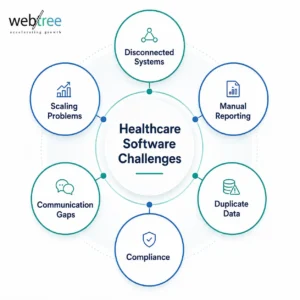
As organizations grow, they often encounter challenges such as:
- Disconnected software systems
- Duplicate data entry
- Manual reporting
- Communication gaps between departments
- Increasing compliance requirements
- Difficulty scaling operations across multiple locations
For example, a hospital may use one application for patient registration, another for payroll, a separate accounting system, and spreadsheets for inventory. These disconnected systems create delays, increase errors, and make decision-making difficult.
Instead of asking “Which software has more features?”, healthcare leaders should ask:
- What operational problems are we trying to solve?
- Which departments need automation?
- How will our software support future growth?
Answering these questions makes choosing between an HMS, an ERP, or a combination of both much easier.
What Is Hospital Management Software?
A Hospital Management System (HMS) is designed to manage the day-to-day clinical and patient-facing operations of healthcare organizations. Its primary objective is to improve patient experience while helping doctors, nurses, and administrative staff work more efficiently.
Whether it’s a small clinic or a multi-specialty hospital, HMS software centralizes clinical workflows into a single platform.
Typical modules include:
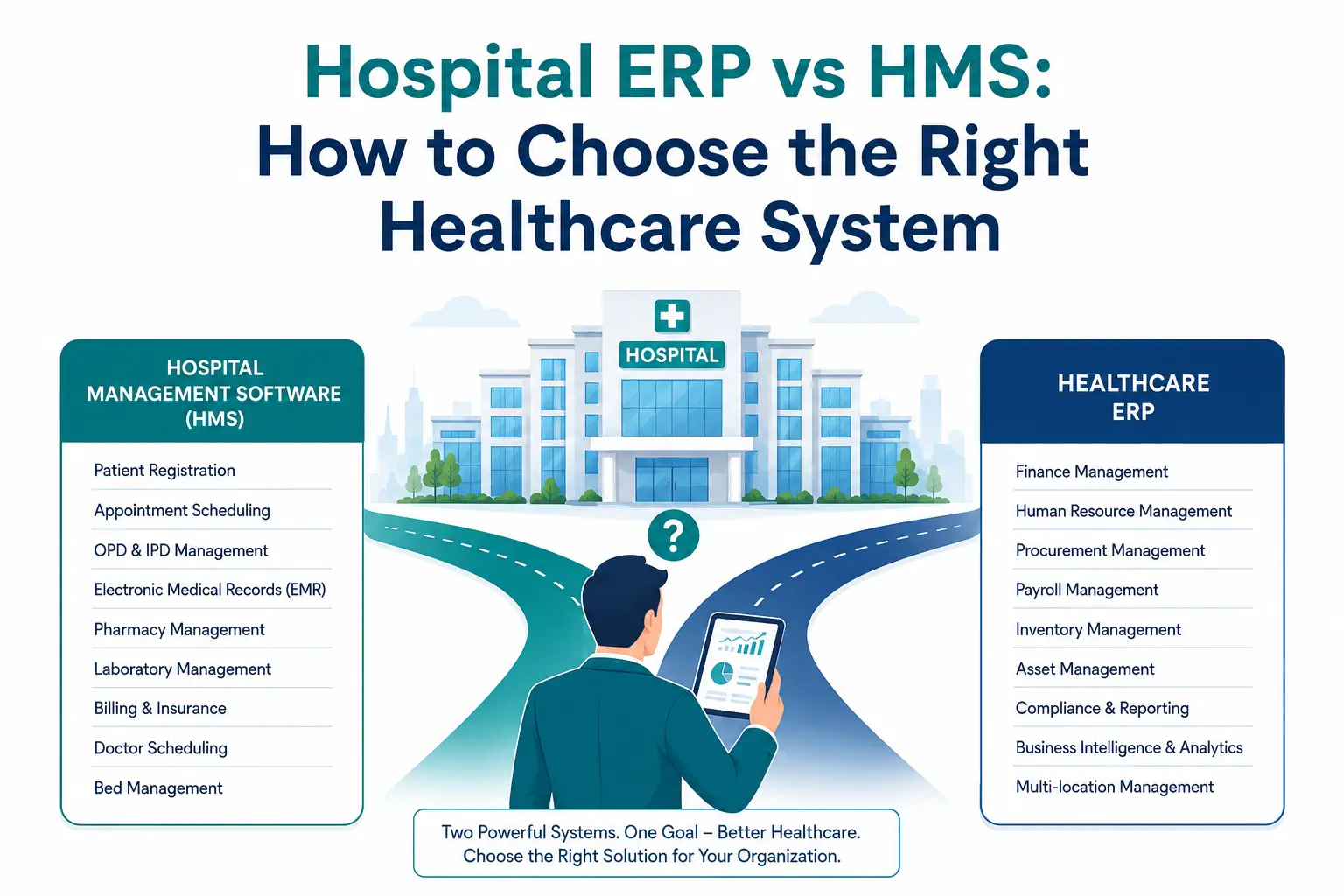
- Patient Registration
- Appointment Scheduling
- OPD & IPD Management
- Electronic Medical Records (EMR/EHR)
- Pharmacy Management
- Laboratory Management
- Billing & Insurance
- Doctor Scheduling
- Bed Management
HMS Modules and Their Benefits
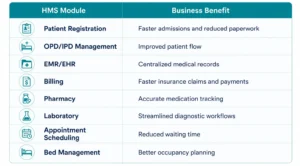
Rather than focusing on business administration, an HMS is built around the patient journey.
For example, when a patient books an appointment, the HMS can automatically create a patient profile, notify the doctor, generate prescriptions, process billing, and maintain complete medical history. This reduces manual work while improving care delivery.
The result is faster admissions, shorter waiting times, better coordination between departments, and a smoother experience for both patients and healthcare professionals.
While Hospital Management Software improves clinical operations, healthcare organizations also need technology that manages the business side of running hospitals. This is where Healthcare ERP becomes an essential part of digital transformation.
What Is Healthcare ERP?
While Hospital Management Software focuses on patient care, Healthcare ERP software manages the operational and financial backbone of a healthcare organization.
Think of ERP as the system that helps hospitals run efficiently behind the scenes. It connects departments such as finance, human resources, procurement, inventory, asset management, and compliance into a single platform. Instead of working with separate software for each function, every department accesses shared, real-time data.
This centralized approach helps reduce duplication, improve decision-making, and streamline operations across the organization.
Common ERP modules include:
- Human Resource Management
- Payroll Processing
- Procurement
- Vendor Management
- Finance and Accounting
- Inventory Management
- Asset Management
- Compliance and Audit
- Supply Chain Management
- Multi-location Administration
ERP Modules and Their Functions
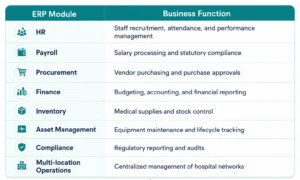
Unlike an HMS, ERP does not manage appointments or patient records. Instead, it provides hospital administrators with complete visibility into business operations.
For example, if a hospital purchases new diagnostic equipment, the ERP system can automatically update procurement records, track vendor payments, register the asset, schedule preventive maintenance, and reflect the expense in financial reports. This level of integration improves operational efficiency and supports better long-term planning.
Hospital Management Software vs ERP: Complete Comparison
Many organizations compare HMS and ERP as if they are competing products. In reality, they address different aspects of hospital management.
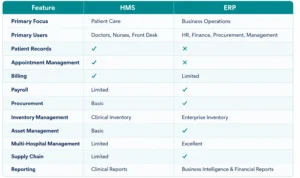
Which Is Better?
There isn’t a single answer because they solve different problems.
Choose Hospital Management Software if your primary goal is improving patient care, streamlining clinical workflows, and digitizing day-to-day hospital operations.
Choose Healthcare ERP if your priority is managing finance, procurement, HR, inventory, and administration across one or multiple healthcare facilities.
For larger organizations, the best solution is often an integrated environment where both systems work together seamlessly.
Understanding the differences between HMS and ERP is only the first step. Hospitals also need a clear strategy for integrating these systems with clinical workflows, administrative processes, and future technologies. Learn how hospitals can successfully navigate digital transformation with our step-by-step guide.
Which Healthcare Organizations Should Choose HMS?
Hospital Management Software is an excellent choice for healthcare providers whose primary focus is delivering efficient patient care.
An HMS is particularly suitable for:
- Single-location hospitals
- Multi-specialty clinics
- Diagnostic centres
- Day-care surgery centres
- Specialty hospitals
- Newly established healthcare facilities
Selecting the right software is only one part of the equation. Hospitals must also address workflow inefficiencies such as manual processes, communication gaps, and fragmented patient journeys to maximize the value of their technology investments. Read our guide on hospital workflow challenges and solutions.
When Does ERP Become the Better Choice?
As healthcare organizations expand, operational complexity grows. Managing multiple hospitals, larger workforces, increased procurement activities, and stricter compliance requirements often demands capabilities beyond a traditional HMS.
Healthcare ERP becomes increasingly valuable for:
- Hospital groups
- Healthcare chains
- Medical universities
- Multi-location healthcare organizations
- Hospitals with large finance and procurement teams
- Enterprises managing multiple business units
Decision Matrix
| Organization Type | Recommended Solution |
|---|
| Clinic | HMS |
| Diagnostic Centre | HMS |
| Specialty Hospital | HMS |
| 300+ Bed Hospital | HMS + ERP |
| Multi-Hospital Group | ERP + HMS |
| Healthcare Enterprise | ERP + HMS |
The decision isn’t based solely on the number of beds. Factors such as operational maturity, future expansion plans, financial complexity, and integration requirements are equally important.
For example, a 150-bed specialty hospital planning to open new branches within the next few years may benefit from implementing an ERP earlier to support long-term scalability.
Modern healthcare organizations are increasingly discovering that choosing between HMS and ERP isn’t always necessary. In many cases, integrating both systems delivers the best results by connecting patient care with business operations.
Why Many Modern Hospitals Use Both HMS and ERP
As healthcare organizations expand, the distinction between clinical operations and business operations becomes less defined. Patient care, finance, procurement, inventory, and staffing are closely connected, making it essential for these functions to work together.
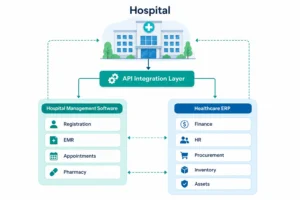
This is why many hospitals adopt both Hospital Management Software (HMS) and Healthcare ERP software. Instead of replacing one system with another, they integrate the two to create a connected digital ecosystem.
Some of the key benefits of integrating HMS and ERP include:
- A single source of accurate data across departments
- Better financial visibility and cost control
- Automated procurement based on inventory levels
- Improved workforce planning
- Faster decision-making with real-time reports
- Easier compliance with healthcare regulations
- Greater scalability for expanding healthcare organizations
Rather than operating in isolation, both systems complement each other. HMS enhances patient care, while ERP strengthens the operational foundation that supports it.
Common Mistakes When Selecting Healthcare Software
Choosing healthcare software is a long-term investment. While features and pricing are important, overlooking broader organizational needs can result in costly implementation challenges.
The table below highlights common mistakes and better approaches.
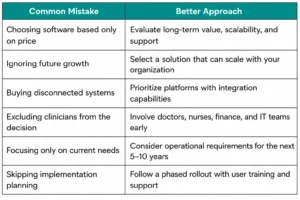
Another common mistake is trying to force one solution to perform every function. An HMS cannot replace a comprehensive ERP for enterprise management, just as an ERP cannot effectively manage patient appointments or electronic medical records. Understanding the role of each system helps organizations invest wisely and avoid unnecessary complexity.
A Practical Decision Framework for Healthcare Leaders
Selecting healthcare software becomes much easier when you follow a structured approach instead of comparing features alone.
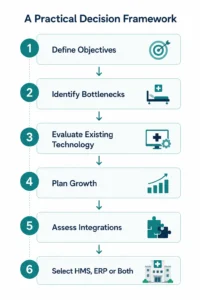
Step 1: Define Your Business Objectives
Start by identifying what you want to achieve. Are you trying to improve patient experience, automate administrative processes, reduce costs, or prepare for expansion? Clear goals help narrow down the right solution.
Step 2: Identify Operational Bottlenecks
Review your current workflows and pinpoint inefficiencies. These may include long patient waiting times, manual billing, inventory shortages, fragmented reporting, or disconnected systems.
Step 3: Evaluate Existing Technology
Assess the software already in use. Determine whether it integrates well, supports current operations, and can adapt to future requirements.
Step 4: Plan for Future Growth
Think beyond your immediate needs. If you expect to open new branches, increase patient volumes, or add new services, choose a platform that can scale without major disruptions.
Step 5: Assess Integration Requirements
Healthcare systems rarely operate independently. Consider how your software will connect with laboratory systems, pharmacy management, finance, insurance providers, diagnostic equipment, and third-party applications.
Step 6: Choose the Right Solution
Based on your assessment:
- Choose HMS if your priority is clinical workflow and patient management.
- Choose ERP if your focus is enterprise-wide administration and resource management.
- Choose an integrated HMS and ERP solution if you require both clinical efficiency and centralized business operations.
This structured approach helps healthcare organizations make informed technology decisions that support both current operations and future growth.
How Webtree Helps Healthcare Organizations Choose the Right Technology
Every healthcare organization operates differently. A diagnostic centre has different technology requirements than a multi-specialty hospital, and a growing hospital chain faces challenges that single-location facilities may never encounter.
Instead of recommending a one-size-fits-all solution, Webtree takes a business-first approach. The focus is on understanding operational goals, identifying process gaps, and recommending technology that aligns with the organization’s long-term vision.
Webtree supports healthcare organizations through:
- Custom Hospital Management Software development
- Healthcare ERP implementation
- System integration and API development
- Workflow automation
- Cloud-based healthcare solutions
- Legacy system modernization
- Ongoing maintenance and technical support
Whether you’re digitizing patient care, streamlining business operations, or building a connected healthcare ecosystem, Webtree helps create solutions that improve efficiency while supporting future growth. Contact us today.
Frequently Asked Questions
What is the difference between Hospital Management Software and ERP?
Hospital Management Software focuses on clinical operations such as patient registration, appointments, medical records, pharmacy, and billing. ERP manages business functions like finance, HR, procurement, inventory, and asset management.
Can a hospital use both HMS and ERP?
Yes. Many hospitals integrate both systems to connect patient care with administrative and financial operations, creating a more efficient and data-driven healthcare environment.
Which is better for a small hospital?
Most small hospitals, clinics, and diagnostic centres benefit from implementing an HMS first. As the organization grows, ERP can be introduced to manage more complex business processes.
Is ERP suitable for multi-location hospital groups?
Yes. ERP is particularly valuable for healthcare groups because it centralizes finance, procurement, inventory, HR, and reporting across multiple facilities.
How do I choose the right healthcare software?
Start by evaluating your organization’s goals, operational challenges, growth plans, and integration requirements. The right solution may be an HMS, an ERP, or a combination of both, depending on your specific needs.