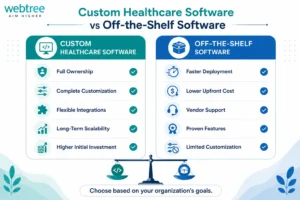
| Evaluation Criteria | Build | Buy |
|---|
| Initial Cost | Higher | Lower |
| Deployment Speed | Slower | Faster |
| Customization | Excellent | Moderate |
| Integration | Highly Flexible | Depends on Vendor |
| Scalability | Excellent | Good |
| Security Control | Full | Shared with Vendor |
| Ownership | Complete | Vendor-Based |
| Maintenance | Managed by Development Partner | Vendor Managed |
When Should You Build Custom Healthcare Software?
Custom development makes sense when software becomes a strategic business asset rather than simply an operational tool.
Here are some common real-world scenarios.
Multi-Location Hospital Networks
A hospital group operating across multiple cities may require centralized patient management, standardized reporting, and location-specific workflows.
Commercial software may struggle to accommodate these varying operational requirements.
Specialized Clinics
A fertility center, oncology hospital, rehabilitation clinic, or mental health provider often follows unique patient journeys.
Custom software can streamline specialized clinical workflows that generic platforms cannot easily support.
Integration-Heavy Environments
Hospitals frequently operate multiple legacy systems alongside newer applications.
Building custom middleware or integrated platforms allows seamless communication across departments without replacing every existing system.
Competitive Differentiation
Organizations investing in digital patient experiences often develop:
- Personalized patient portals
- Mobile healthcare apps
- AI-powered appointment systems
- Custom telemedicine platforms
These capabilities create competitive advantages that standardized software cannot replicate.
Long-Term Digital Transformation
Organizations with ambitious digital transformation roadmaps benefit from software that evolves alongside their strategy rather than being constrained by vendor limitations.
When Buying Healthcare Software Is the Better Choice
Not every healthcare organization requires custom software. Commercial solutions work exceptionally well in many situations.
Buying may be the better option if your organization:
- Operates with standardized clinical workflows
- Has limited IT resources
- Requires rapid implementation
- Has a constrained technology budget
- Needs proven compliance capabilities
- Prefers vendor-managed maintenance
Small clinics, diagnostic centers, dental practices, and newly established healthcare facilities often gain significant value from commercial healthcare platforms.
Signs You Should Buy Instead of Build
- You need software quickly.
- Your workflows closely match industry standards.
- Budget constraints limit custom development.
- You lack dedicated technical resources.
- Vendor support is an important requirement.
- You prefer predictable subscription costs.
The Hybrid Approach: When Building and Buying Together Makes Sense
Many organizations assume they must choose either custom software or commercial software.
In reality, many modern hospitals adopt a hybrid strategy.
This approach combines the reliability of commercial platforms with the flexibility of custom development.
Examples include:
Buy an EHR, Build a Patient Portal
A hospital may use a commercial Electronic Health Record system while developing a custom patient portal tailored to its brand and patient engagement strategy.
Buy ERP, Build Analytics Dashboards
Commercial ERP software can handle finance and procurement, while custom dashboards provide executives with real-time operational insights.
Buy HR Software, Build Clinical Workflows
Human resource management can remain standardized while patient admission, discharge, and treatment workflows are customized.
API Integrations
Modern healthcare platforms increasingly support APIs that allow organizations to connect different systems securely.
Middleware Solutions
Custom middleware enables multiple healthcare applications to exchange information efficiently without replacing existing investments.
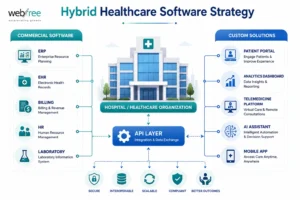
The hybrid approach offers flexibility, faster implementation, and reduced costs while preserving opportunities for innovation.
Many hospitals adopt a hybrid approach as part of a broader digital transformation strategy, allowing existing systems to integrate with new custom applications while minimizing operational disruption. If you’re planning a hospital modernization initiative, explore our step-by-step healthcare digital transformation roadmap.
A Decision Framework for Healthcare Leaders
Before selecting any healthcare software strategy, healthcare leaders should answer several important questions.
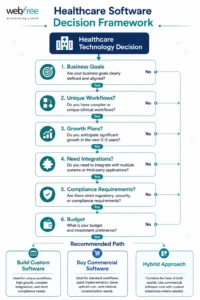
What are your business goals?
Are you improving efficiency, expanding services, enhancing patient experience, or reducing costs?
Which processes make your organization unique?
The more specialized your workflows, the greater the value of customization.
Do you need competitive differentiation?
If technology plays a strategic role in attracting patients, custom development may provide stronger long-term advantages.
What budget is available?
Consider both upfront investment and total cost of ownership over several years.
Do you have internal IT capabilities?
Determine whether your team can manage software or whether ongoing support from a development partner is preferable.
What compliance requirements apply?
Evaluate regulatory obligations alongside security, privacy, and audit requirements.
What are your growth plans?
Choose software that can support additional locations, users, services, and technologies without requiring major redevelopment.
How long does it typically take to build custom healthcare software compared to implementing an off-the-shelf solution?
Off-the-shelf software can often be implemented within a few weeks to several months, depending on configuration and migration requirements. Custom healthcare software generally takes several months, depending on project complexity, integrations, testing, and compliance needs. Although it requires more time initially, it provides greater flexibility and long-term value for organizations with unique operational requirements.
Why Healthcare Organizations Choose Webtree
Successful healthcare software goes beyond coding. It requires a deep understanding of clinical operations, patient experiences, security, and scalable technology architecture.
Webtree develops healthcare software solutions that help hospitals, clinics, and healthcare providers modernize operations while preparing for future growth.
Our expertise includes:
- Custom healthcare software development
- Hospital management systems
- Patient portals
- Workflow automation
- Secure cloud-based applications
- Third-party system integration
- Legacy system modernization
- Scalable healthcare platforms
- Ongoing maintenance and support
Rather than offering one-size-fits-all solutions, Webtree works closely with healthcare organizations to identify the most suitable technology strategy, whether that involves building, buying, or combining both approaches. Ready to modernize your healthcare technology? Schedule a free consultation with our experts to discuss your clinical workflows, integration requirements, and long-term digital transformation goals.
Frequently Asked Questions
How do hospitals calculate the ROI of building custom healthcare software?
Hospitals evaluate ROI by comparing development costs against long-term savings from improved operational efficiency, reduced manual work, lower licensing expenses, better patient experiences, and increased staff productivity.
Can existing healthcare software be customized without rebuilding everything?
Yes. Many commercial healthcare platforms support configuration, API integrations, and custom modules that extend functionality without replacing the core system.
What hidden costs should organizations consider before buying healthcare software?
Beyond licensing fees, organizations should consider implementation costs, staff training, data migration, customization, integration, ongoing subscriptions, vendor support, and future upgrade expenses.
How can healthcare providers avoid vendor lock-in when purchasing software?
Choose platforms with open APIs, strong integration capabilities, flexible data export options, and transparent licensing terms. Working with an experienced technology partner also helps reduce dependency on a single vendor.
Is a hybrid build-and-buy approach suitable for growing hospitals?
Absolutely. Many growing healthcare organizations use commercial software for standardized functions while building custom applications for patient engagement, analytics, specialized workflows, and integrations.