Key Highlights
- AI in education can support teaching, learning, administration, student services, and institutional decision making.
- AI can enable personalized and adaptive learning based on individual student performance and learning needs.
- AI tutors and student support chatbots can provide students with 24/7 assistance for academic and administrative queries.
- AI can help educators with lesson planning, quiz generation, assessment support, feedback, and content preparation.
- AI powered accessibility tools such as speech to text, text to speech, captions, and translation can support inclusive education.
- Schools and universities can use AI to automate admissions, attendance, scheduling, document processing, reporting, and other repetitive workflows.
- Predictive analytics can help institutions identify patterns in attendance, engagement, academic performance, and student retention.
- AI should support teachers and administrative teams rather than replace human judgment, especially for decisions affecting students.
- Successful AI adoption requires data privacy, security, staff training, system integration, human oversight, and clear AI usage policies.
- Webtree can combine AI, custom software, integrations, and cloud technologies to build scalable AI solutions for schools and universities.
Artificial intelligence is changing how schools and universities approach teaching, student support, administration, and institutional decision making. What was once treated as an emerging technology is now becoming a practical tool that can help educational institutions handle repetitive tasks, personalize learning, support educators, and improve the student experience.
AI in education refers to the use of artificial intelligence technologies to support teaching, learning, student services, administration, and decision making across educational institutions. Its role can range from helping a student understand a difficult topic to automating administrative workflows and identifying students who may need additional support.
For schools and universities, the goal is not to replace teachers or administrative teams. Instead, AI can work alongside people to reduce repetitive work, provide useful insights, and make educational services more accessible and responsive.
AI Use Cases in Teaching and Learning
Personalized Learning Paths
Students do not all learn at the same speed or in the same way. AI can analyze information such as performance, completed coursework, and areas of difficulty to recommend learning materials that match individual needs.
For example, a student struggling with a particular mathematical concept could receive additional exercises and supporting content, while another student who has already mastered the topic can move to more advanced material.
This can help teachers provide more targeted support without manually creating a separate learning path for every student.
Adaptive Learning
Adaptive learning systems can adjust the difficulty, pacing, or type of content presented to students based on their performance.
If a student repeatedly struggles with a topic, the system can provide additional practice or simpler explanations. When performance improves, it can introduce more challenging material.
This makes learning more responsive to individual progress.
AI Tutoring and 24/7 Student Assistance
AI tutors can provide students with immediate assistance when teachers are unavailable. They can explain concepts, answer routine academic questions, provide practice questions, and guide students through learning materials.
An AI tutor does not have to replace classroom teaching. Instead, it can provide additional support outside regular teaching hours.
Automated Feedback
AI can assist with reviewing assignments and providing preliminary feedback. It can identify common errors, highlight areas that may require attention, and help students understand where they can improve.
Teachers can then review and refine the feedback where necessary, particularly for assignments requiring detailed judgment.
AI-Assisted Lesson Planning
Teachers spend considerable time preparing lessons and learning materials. AI can help generate lesson-plan structures, suggest activities, create discussion questions, and adapt existing content for different levels.
The educator remains responsible for deciding what is appropriate for the classroom, but AI can reduce the amount of time spent on repetitive preparation.
Quiz and Assessment Generation
AI can generate practice questions and quizzes based on a topic, difficulty level, or learning objective. Educators can review and modify these questions before using them with students.
This can make it easier to create different versions of practice assessments and provide students with more opportunities to test their knowledge.
Interactive Learning and Content Recommendations
AI can also support simulations, interactive learning activities, and content recommendations. Based on student interests and performance, systems can suggest additional resources that complement classroom learning.
AI for Accessibility and Inclusive Education
Accessibility should be a core consideration when educational institutions adopt AI.
Tools such as speech-to-text, text-to-speech, automated captions, real-time translation, and language assistance can make educational content easier to access for a wider range of students.
For students with disabilities, speech recognition and text-to-speech tools can provide alternative ways to interact with learning materials. Students who learn at different speeds can also receive more personalized assistance.
Language support can be particularly useful in diverse educational environments. AI-powered translation and language assistance can help students engage with content and communicate more effectively.
The value of AI in this area is not simply convenience. It can help institutions create learning environments that accommodate different needs.
AI for School and University Administration
Educational institutions manage large volumes of repetitive administrative work. AI can help streamline many of these processes.
Common AI use cases in education administration include:
- Attendance automation
- Timetable and scheduling assistance
- Automated grading support
- Admissions processing
- Student record management
- Financial aid document processing
- Transcript analysis
- Accreditation documentation
- Administrative reporting
Consider an admissions workflow. Without automation, staff may need to manually review documents, enter information, respond to routine questions, and track applications.
With AI-supported workflows, documents can be processed more efficiently, routine information can be extracted, and applicants can receive automated updates.
The staff still oversee the process, but they spend less time on repetitive tasks.
Before AI vs With AI
| Process | Before AI | With AI |
| Attendance | Manual tracking and reporting | Automated data capture and reporting |
| Admissions | Manual document review | AI-assisted document processing |
| Student queries | Staff respond individually | AI assistant handles routine questions |
| Reporting | Manual data compilation | Automated report generation |
| Scheduling | Manual coordination | AI-assisted scheduling |
| Documents | Manual information extraction | Automated data extraction |
AI-Powered Student Support and Communication
Students often have questions that do not require direct intervention from a staff member.
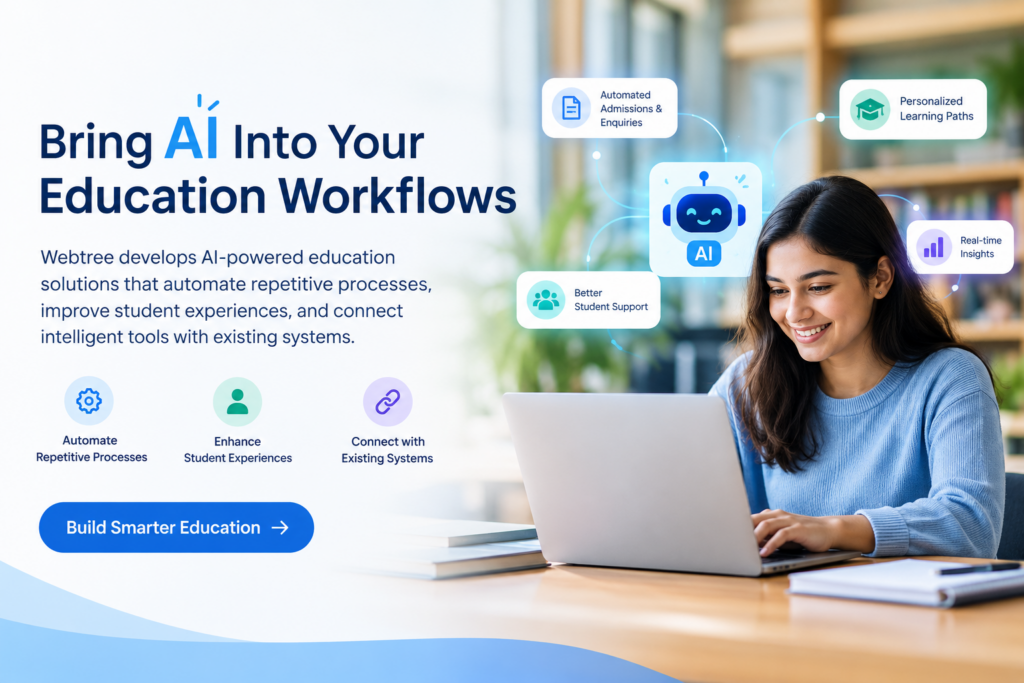
Questions about application deadlines, fees, course information, campus services, appointments, and routine procedures can often be handled by an AI-powered assistant.
Schools and universities can use AI for:
- Student support chatbots
- Admissions assistants
- Campus information assistants
- Fee and deadline queries
- Course-related questions
- Appointment scheduling
- Automated notifications
- 24/7 student support
An AI chatbot can provide immediate answers at any time, while more complex matters can be transferred to the appropriate member of staff.
This creates a human plus AI support model, rather than treating AI as a complete replacement for student support teams.
How Can AI Improve Student Support?
AI can improve student support by providing faster responses to routine questions, making information available around the clock, automating notifications, and directing students to the right resources or staff members. This allows support teams to focus more attention on complex issues that require human interaction.
Using AI to Predict Student Needs and Improve Retention
AI can also help institutions move from reacting to student problems to identifying potential issues earlier.
Predictive analytics can examine patterns related to:
- Enrollment
- Student retention
- Attendance
- Academic performance
- Engagement
- Dropout risk
- Students requiring additional support
For example, if a university identifies patterns associated with disengagement, staff may be able to reach out to students earlier and offer appropriate support.
However, there is an important distinction between predictive insights and automated decision making.
AI should provide information that helps educators and administrators make better decisions. It should not automatically determine a student’s future based solely on an algorithmic prediction, particularly when the decision could significantly affect the student’s education.
AI for Teachers and Educators
AI can reduce the administrative workload faced by teachers and educators.
It can assist with lesson-plan generation, assessment creation, question generation, feedback, content summarization, research assistance, and administrative documentation.
This gives educators more time to focus on teaching, mentoring, classroom interaction, and individual student needs.
The most useful model is therefore AI augmenting educators rather than replacing them.
Teachers bring context, experience, judgment, empathy, and personal understanding of their students. AI can provide assistance, but those human qualities remain central to education.
How AI Can Improve the Student Journey
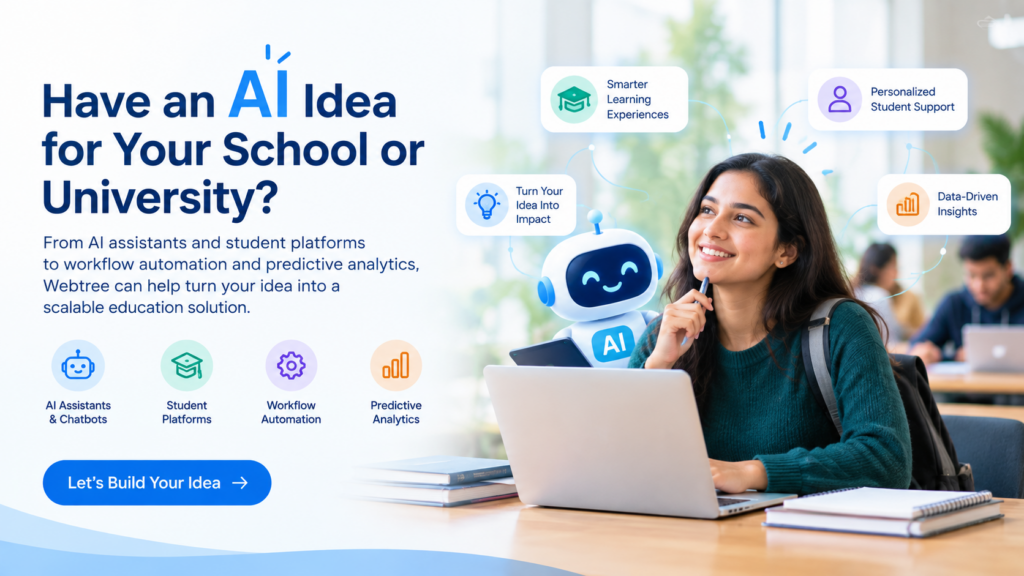
AI opportunities can be mapped across the entire student journey:
- During admissions, AI can support application processing and routine applicant queries.
- During enrollment, it can assist with document processing, communication, and administrative workflows.
- During learning, personalized and adaptive systems can recommend content and provide additional assistance.
- During assessment, AI can support quiz creation, feedback, and grading workflows.
- During student support, AI assistants can answer routine questions and connect students with relevant services.
- Before graduation, institutions can use AI-supported communication and administrative workflows to help students complete required processes.
- Even after graduation, AI can support alumni communication and engagement.
This journey-based approach allows institutions to identify specific areas where AI can deliver value instead of attempting to introduce AI everywhere at once.
AI in Education: School vs University Use Cases
Although schools and universities can use many of the same AI technologies, their requirements can differ.
| Area | Schools | Universities |
| Personalized learning | ✓ | ✓ |
| AI tutoring | ✓ | ✓ |
| Admissions | ✓ | ✓ |
| Student support | ✓ | ✓ |
| Research assistance | Limited | ✓ |
| Predictive analytics | ✓ | ✓ |
| Accreditation workflows | Limited | ✓ |
| Campus operations | Limited | ✓ |
Schools may place greater emphasis on classroom learning, accessibility, teacher support, and student communication. Universities may require broader systems covering research, admissions, campus operations, accreditation, and large-scale student services.
What Are the Benefits of AI in Education?
When implemented around specific institutional needs, AI can provide several benefits.
Personalized learning: Students can receive content and support based on their individual progress.
Reduced educator workload: Teachers can automate or accelerate repetitive preparation and administrative tasks.
Faster administration: Document processing, reporting, scheduling, and other workflows can become more efficient.
Better student engagement: Faster access to information and personalized learning can make student interactions more responsive.
Improved accessibility: Speech, translation, captioning, and language tools can support a wider range of learners.
Faster student support: AI assistants can respond to routine queries around the clock.
Better decision making: Analytics can help institutions identify patterns and make more informed decisions.
Better use of data: AI can help institutions turn existing data into useful insights.
Institutions should measure these benefits through practical KPIs such as administrative processing time, student engagement, course completion, retention, teacher workload, student support response time, assistant resolution rate, adoption, cost per process, and student satisfaction.
Challenges and Risks of Using AI in Education
AI adoption also comes with responsibilities.
| Challenge | Risk | Recommended Safeguard |
| Student data | Privacy concerns | Strong data governance |
| AI outputs | Incorrect information | Human review |
| Algorithmic decisions | Bias | Regular testing and oversight |
| Academic use | Integrity concerns | Clear AI usage policies |
| Staff adoption | Poor implementation | Training and support |
| Accessibility | Exclusion of users | Accessibility-focused design |
| Existing systems | Integration problems | API and system assessment |
| AI dependency | Over-reliance | Maintain human oversight |
Student data privacy and security should be considered from the beginning of an AI project. Institutions should also establish clear policies covering acceptable AI use, academic integrity, data handling, and human oversight.
AI-generated information should not automatically be treated as accurate. Human review remains important, especially when AI is used in academic assessment, student support, or decisions affecting student outcomes.
How Schools and Universities Can Start Using AI
A phased approach can make AI adoption more manageable.
Phase 1: Identify High-Value Use Cases
Start with a specific problem rather than simply adopting AI because it is popular. Look for repetitive processes, common student queries, or areas where educators need additional support.
Phase 2: Assess Existing Systems and Data
Review the systems currently used by the institution. This could include student information systems, CRM platforms, ERP systems, learning platforms, and communication tools.
Phase 3: Start With a Controlled Pilot
Test one clearly defined application before expanding across the institution. Lower-risk administrative or support use cases can be a practical starting point.
Phase 4: Train Teachers and Administrative Staff
Successful adoption depends on people understanding how to use AI effectively. Staff should know what the system can do, where human review is needed, and how data should be handled.
Phase 5: Measure Outcomes
Track KPIs such as response time, processing time, adoption, workload, student satisfaction, and resolution rates.
Phase 6: Scale Successful Applications
Once a pilot demonstrates measurable value, the institution can expand the solution and introduce additional AI applications.
How to Choose an AI Technology Partner for Education
Choosing the right technology partner is important because education systems involve sensitive information, multiple stakeholders, and complex workflows.
Look for a partner with experience in:
- Education technology
- AI and machine learning
- Custom software development
- Student information system integration
- CRM and ERP integration
- API development
- Cloud infrastructure
- Data security
- UI/UX design
- Scalable software architecture
- Post-launch support
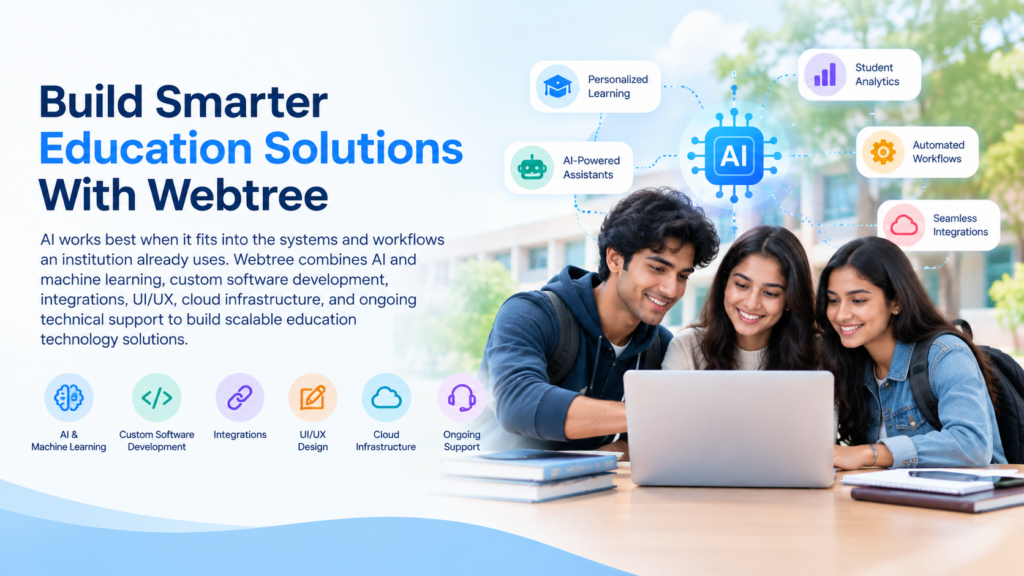
The right partner should look beyond developing an isolated AI tool. A useful education solution needs to work with the institution’s existing technology ecosystem.
This is where Webtree can add value by combining AI, custom software, and existing institutional systems rather than treating AI as a standalone product.
Measuring the Success of AI in Education
AI implementation should be measured against clear outcomes.
Useful KPIs include:
- Student engagement
- Course completion
- Student retention
- Administrative processing time
- Teacher workload
- Student support response time
- AI assistant resolution rate
- Adoption rate
- Cost per administrative process
- Student satisfaction
These measurements help institutions determine whether an AI initiative is actually solving the problem it was designed to address.
AI in education should not be measured simply by how advanced the technology appears. Its real value comes from whether it improves learning, reduces unnecessary workload, supports students, or makes institutional operations more efficient.
Conclusion
AI in education is moving beyond experimentation and into practical applications across teaching, learning, administration, accessibility, student support, and institutional decision making.
Schools and universities can use AI to personalize learning, assist teachers, automate repetitive processes, provide 24/7 student support, and identify patterns that may help staff respond to student needs earlier.
However, successful implementation requires more than adding an AI tool. Institutions need clear objectives, appropriate safeguards, reliable data, system integration, staff training, and continuous measurement.
Most importantly, AI should support the people at the center of education. Teachers, administrators, support teams, and students should remain part of the process.
With the right strategy and technology partner, AI can become a practical part of an institution’s digital ecosystem, helping schools and universities create more efficient, accessible, and student-focused experiences.
Frequently Asked Questions
What are the most common uses of AI in education?
Common uses include personalized learning, AI tutoring, assessment assistance, lesson planning, accessibility tools, student support, admissions processing, administrative automation, and predictive analytics.
How can AI help teachers and educators?
AI can assist teachers with lesson planning, quiz creation, question generation, content summarization, feedback, assessment support, research assistance, and routine administrative tasks.
How can schools use AI for administration?
Schools can use AI for attendance, scheduling, admissions support, document processing, student communication, reporting, and other repetitive administrative workflows.
Can AI personalize learning for students?
Yes. Adaptive AI systems can analyze student performance and adjust learning content, difficulty, pacing, and recommendations according to individual learning needs.
How can universities use AI to improve student retention?
Universities can use predictive analytics to identify patterns associated with disengagement or dropout risk. Staff can then use these insights to provide timely and appropriate support.
What are the risks of using AI in education?
Key risks include student data privacy, security, algorithmic bias, inaccurate AI outputs, academic integrity concerns, over-reliance on AI, insufficient staff training, and integration challenges.
Will AI replace teachers in schools and universities?
AI is more effectively used to augment educators. It can reduce repetitive work, provide insights, and support personalized learning while teachers continue to provide human guidance, judgment, mentorship, and classroom interaction.