Key Highlights
- Digital transformation in education connects learning, administration, data and technology into one ecosystem.
- Schools and universities should assess their digital maturity before selecting new technology.
- AI, LMS platforms, cloud, ERP, mobile apps, analytics and AR/VR can support different areas of education.
- Integrating systems is important to avoid disconnected platforms and data silos.
- A phased digital transformation in education roadmap makes implementation easier to manage.
- Success should be measured through student experience, learning, operational and business outcomes.
What Is Digital Transformation in Education?
Digital transformation in education is more than introducing computers, an LMS or online classes. It is the process of using technology to improve teaching, learning, student services, administration and institutional management.
A useful way to look at it is the transition from individual digital tools to a connected institutional ecosystem.
For example, an institution may already have an LMS, student information system and accounting software. If these systems do not communicate with each other, staff may still need to enter the same information multiple times. Students may also have to use different platforms for admissions, learning, fees and support.
The difference can be explained simply:
| Stage | What It Means | Example |
| Digitization | Converting information into digital form | Paper records converted into digital files |
| Digitalization | Using technology to improve an existing process | Online fee payments |
| Digital Transformation | Connecting technology, processes, people and data | An integrated ecosystem connecting admissions, ERP, LMS, mobile and analytics |
This is why education digital transformation should focus on the entire institution rather than one software platform.
Why Digital Transformation Matters for Educational Institutions
Why is digital transformation important in education?
Student expectations are changing. Learners increasingly expect convenient access to information, digital communication, flexible learning options and faster support. At the same time, educational institutions face growing administrative workloads and increasing demand for accurate, real time data.
Digital transformation can help institutions:
- Improve student engagement and experience
- Support hybrid and flexible learning
- Reduce repetitive administrative work
- Improve faculty productivity
- Personalize learning experiences
- Access institutional data faster
- Improve student retention
- Streamline admissions and fee management
- Create more efficient operations
The goal is not to digitize everything simply because technology is available. The goal is to make the institution work better.

Assessing Your Institution’s Digital Maturity
Before creating a digital transformation in education roadmap, institutions need to understand where they currently stand.
Assess areas such as:
- IT infrastructure
- LMS, SIS and ERP systems
- Student experience
- Administrative processes
- Data and analytics
- Cloud readiness
- Cybersecurity
- System integration
- Faculty digital readiness
Digital Maturity Checklist
Ask:
- Are key student processes still manual?
- Do different departments use disconnected systems?
- Can administrators access real time data?
- Can students complete important services online?
- Are existing systems integrated?
- Are staff and faculty comfortable using digital tools?
- Is institutional data secure and properly managed?
Expert Tip: Do not start your transformation by choosing software. Start by identifying the processes that consume the most time, create the most errors or negatively affect the student experience. Technology should solve these problems rather than simply add another platform.
Map the Student Journey Before Choosing Technology
One of the most effective ways to plan digital transformation for schools and universities is to map the complete student journey.
At each stage, identify:
- Current process
- Manual bottlenecks
- Existing technology
- Data gaps
- Automation opportunities
- Student experience issues
This process first approach helps institutions identify where technology can create the greatest value instead of buying platforms based on trends.
Key Technologies Driving Digital Transformation in Education
Different technologies solve different institutional challenges.
| Technology | Education Use | Primary Benefit |
| AI | Personalization and automation | Better learning and efficiency |
| LMS | Course delivery and assessment | Centralized learning |
| Cloud | Infrastructure and collaboration | Accessibility and scalability |
| ERP/SIS | Administration and student records | Operational efficiency |
| Mobile Apps | Communication and campus services | Better accessibility |
| Analytics | Performance and KPI monitoring | Better decisions |
| AR/VR | Simulations and immersive learning | Higher engagement |
AI and Machine Learning
AI can support personalized learning, AI tutoring, predictive analytics, student risk identification and administrative automation.
Learning Management Systems
An LMS can centralize courses, assignments, assessments, communication and progress tracking, giving students and faculty one place to manage learning activities.
Cloud Platforms
Cloud technology provides scalable infrastructure, centralized access and easier collaboration while supporting access to educational systems from different locations.
Education ERP and Student Information Systems
ERP and SIS platforms can bring admissions, fees, student records, HR, finance and scheduling into a more organized environment.
Mobile Applications
Education mobile apps can support notifications, attendance, fees, learning access, communication and campus services.
Data Analytics and Dashboards
Dashboards can bring together information about enrollment, student performance, retention, faculty activity and institutional KPIs.
AR/VR and Immersive Learning
AR and VR can support virtual laboratories, simulations, practical training and virtual campus experiences, particularly where hands on learning is important.
How AI Is Changing Education and Administration
How is AI used in education?
AI can support both learning and administration.
For learning, applications include adaptive learning, AI tutors, personalized content, automated feedback, accessibility tools and lesson planning.
For administration, AI can assist with admissions, attendance, scheduling, document processing, student support chatbots, enrollment forecasting and retention analytics.
However, responsible implementation matters. Institutions should maintain human oversight and consider data privacy, accuracy, bias, transparency and faculty involvement when introducing AI.
Building a Connected Education Technology Ecosystem
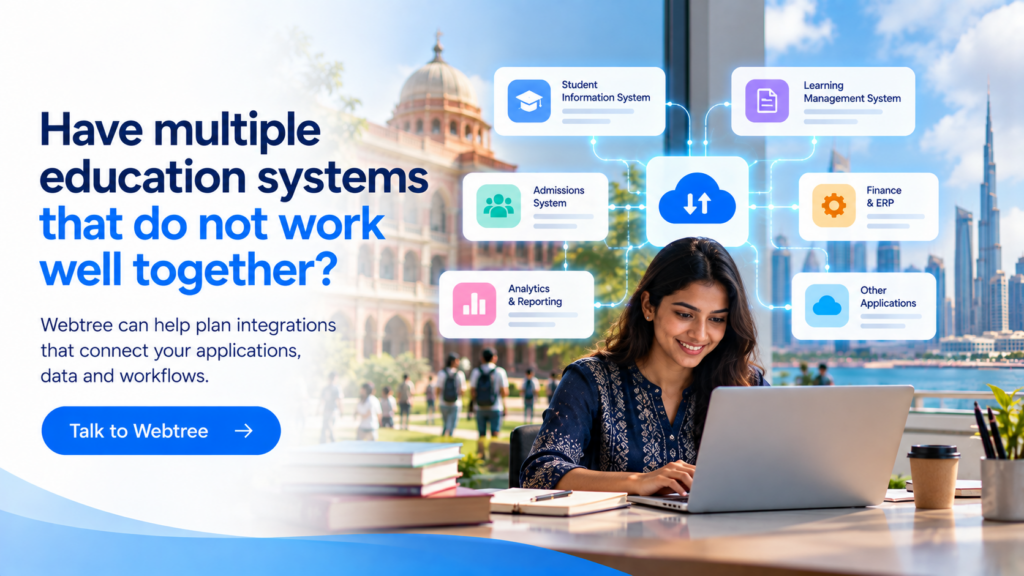
The real value of education technology solutions comes from how different systems work together.
APIs and integrations allow relevant information to move between systems, reducing duplicate data entry and creating a more consistent experience.
Important considerations include:
- API integration
- Data synchronization
- Single source of truth
- Identity and access management
- Centralized reporting
- Third party integrations
- Data security
Webtree can support this connected approach through custom software development, web and mobile applications, ERP solutions, AI, cloud technologies and system integrations.
A Step by Step Digital Transformation Roadmap
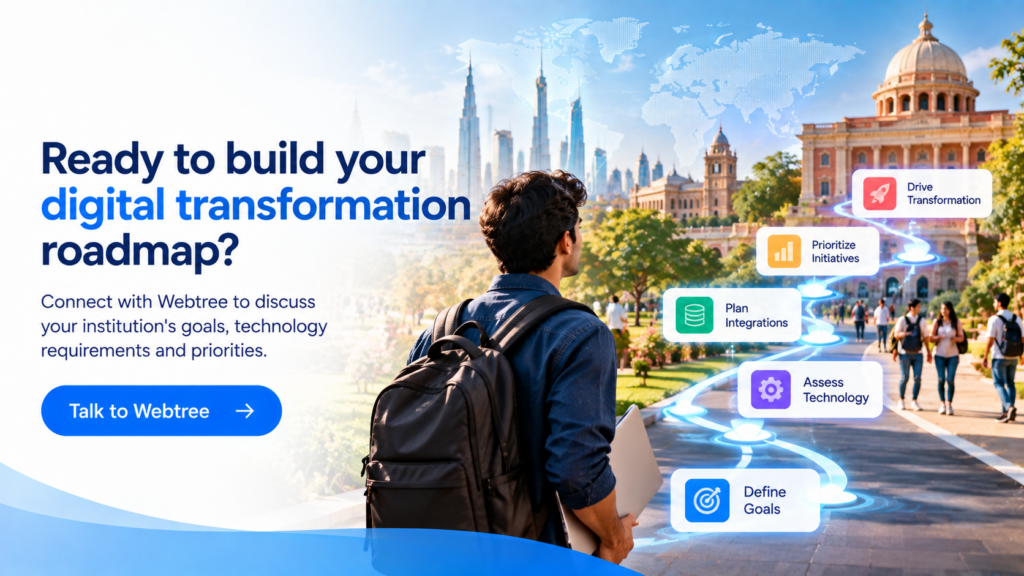
A practical digital transformation in education roadmap can follow these ten steps.
Step 1: Define Institutional Goals
Start with clear outcomes such as improving student experience, reducing administrative workload, increasing enrollment, improving retention or reducing operational costs.
Step 2: Assess Digital Maturity
Review your infrastructure, systems, processes, data, cybersecurity and staff readiness.
Step 3: Map Existing Processes
Document how students, faculty and administrators currently complete important tasks.
Step 4: Prioritize High Impact Opportunities
Use an Impact vs Effort framework. Prioritize initiatives that offer meaningful improvements without unnecessary complexity.
Step 5: Select the Technology Stack
Choose platforms based on your institutional requirements, integration needs, scalability and budget.
Step 6: Integrate Existing Systems
Connect systems through APIs and data integrations wherever practical instead of replacing every existing platform.
Step 7: Pilot Before Scaling
Test new solutions with a department, course, campus or specific workflow before implementing them institution wide.
Step 8: Train Faculty and Staff
Technology adoption depends on people. Provide practical training and involve users early in the process.
Step 9: Measure Results
Track KPIs related to student experience, learning, administration, business performance and technology adoption.
Step 10: Continuously Improve
Digital transformation is an ongoing process. Use data and feedback to improve systems and introduce new capabilities when they create genuine value.
Common Digital Transformation Challenges and Mistakes
| Common Mistake | Better Approach |
| Buying software first | Start with institutional goals |
| Too many disconnected tools | Build an integrated ecosystem |
| Ignoring faculty | Involve users early |
| Transforming everything at once | Use phased implementation |
| Poor data quality | Establish data standards |
| Weak cybersecurity | Build security into implementation |
| No success metrics | Establish clear KPIs |
Trying to transform the entire institution at once can create unnecessary disruption. A phased approach usually makes it easier to manage budgets, adoption and technical challenges.
How to Measure Digital Transformation Success
The number of systems implemented is not a measure of success. Institutions should measure whether those systems create meaningful outcomes.
Student Experience
- Student satisfaction
- Digital service adoption
- Support response time
Learning
- LMS engagement
- Assessment completion
- Student performance
Administration
- Admission processing time
- Document processing time
- Staff productivity
Business
- Enrollment conversion
- Student retention
- Cost per transaction
Technology
- System uptime
- Integration success
- Platform adoption
Expert Tip: Measure transformation by outcomes, not the number of systems implemented. A new LMS or ERP is not a success metric by itself. Track whether it reduces processing time, improves adoption, increases student engagement or delivers measurable operational value.
How to Choose the Right Education Technology Partner
Whether you are planning digital transformation for schools or digital transformation for universities, the technology partner you choose can significantly affect the outcome.
Look for experience in:
- Education technology
- Custom software development
- ERP, SIS and LMS integration
- AI implementation
- Web and mobile development
- Cloud solutions
- API integration
- Data security
- Scalability
- Training and ongoing support
The ideal partner should look beyond individual software products and understand how technology, processes and people need to work together.
Webtree brings together custom software, AI, ERP, web and mobile development, cloud solutions and integrations to help educational institutions build connected digital ecosystems.
FAQs
How long does digital transformation take in education?
It depends on the institution’s size, goals, existing technology and project scope. Smaller initiatives may take a few months, while broader transformation programs can take several years.
What are the biggest challenges of digital transformation in education?
Common challenges include disconnected systems, poor data quality, cybersecurity concerns, limited budgets, faculty adoption, integration issues and lack of a clear strategy.
How much does digital transformation in education cost?
There is no fixed cost. It depends on factors such as the number of users, systems, integrations, custom development, cloud infrastructure and AI requirements.
How can educational institutions measure digital transformation success?
Institutions can track student satisfaction, digital adoption, learning engagement, processing times, staff productivity, enrollment, retention, system uptime and other relevant KPIs.
Should schools build custom software or use existing education platforms?
It depends on the institution’s requirements. Existing platforms can be effective for standard functions, while custom software can address unique workflows and integrate systems that do not work well together.
What is the first step in digital transformation?
Start by defining institutional goals and identifying the processes that create the greatest operational or student experience challenges. Then assess digital maturity before selecting technology.