Key Highlights
- Real estate mobile app development can help property businesses improve lead generation, customer engagement, property discovery, and sales efficiency.
- Essential real estate app features should serve buyers, tenants, agents, property managers, and administrators.
- AI recommendations, intelligent search, virtual tours, document scanning, and predictive analytics can make a property app more useful and competitive.
- CRM, ERP, payment, maps, marketing, and analytics integrations help connect the app with existing business operations.
- A successful property app should be secure, scalable, easy to use, and designed around clear business objectives rather than an overloaded feature list.
Why Mobile Apps Are Becoming Essential for Real Estate Businesses
Property searches have become increasingly mobile. Buyers and tenants want to browse listings, compare properties, contact agents, schedule viewings, and receive updates without being tied to a desktop.
For real estate businesses, a mobile application offers more than another channel for displaying properties. It creates a direct connection with customers throughout the property journey, from the first search to booking a viewing, submitting documents, making payments, and receiving post-sale or post-rental support.
Websites remain important, particularly for search visibility and attracting new visitors. However, mobile apps can provide a more personalized experience. Features such as saved searches, push notifications, location-based recommendations, in-app messaging, and personalized dashboards encourage users to return.
For brokers and agents, a real estate mobile application can also reduce manual work. Agents can manage listings, respond to leads, schedule appointments, upload documents, and communicate with prospects from a single platform.
Property managers can use apps to support tenants, manage maintenance requests, share documents, collect payments, and maintain communication after a lease begins.
The real value is therefore not simply putting property listings on a phone. It is creating a digital experience that supports the complete customer lifecycle.
Different Types of Real Estate Mobile Apps
The right app structure depends on the type of property business and its users.
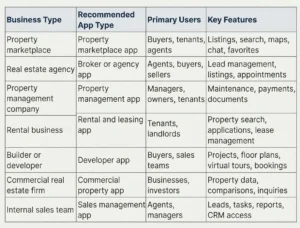
Choosing the app type early helps determine which features should be included in the MVP and which can be introduced later.
Core Features Every Real Estate Mobile App Should Include
A successful property app needs different capabilities for different user groups. A buyer does not need the same interface as an agent or administrator.
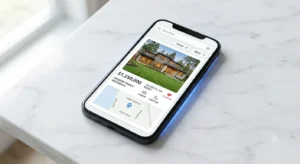 Buyer and Tenant Features
User registration and profiles: Users should be able to register using email, phone number, or supported social login options. Profiles can store preferences such as location, property type, budget, and preferred amenities.
Property listings: Each listing should provide essential information including price, location, property type, size, bedrooms, bathrooms, amenities, availability, and relevant property details.
High-quality image galleries: Real estate is highly visual. Multiple images, floor plans, videos, and high-resolution galleries help users evaluate properties before arranging a visit.
Advanced search and filters: Users should be able to filter properties by price, location, property type, size, bedrooms, amenities, availability, and other business-specific criteria.
Favorites and saved properties: Users can save properties they are interested in and return to them later.
Property comparison: A comparison tool lets users evaluate several properties based on price, size, location, amenities, and other relevant criteria.
Mortgage and EMI calculator: Financial calculators can help buyers estimate monthly payments and understand affordability before contacting an agent.
Interactive maps: Map integration allows users to explore property locations and nearby areas.
Nearby amenities: Showing schools, hospitals, shopping centers, transport links, restaurants, and other points of interest can help users make better decisions.
Push notifications: Notifications can alert users about new listings, price changes, viewing appointments, open houses, and saved-search matches.
Open house alerts: Users can receive information about upcoming property viewings and events.
Agent Features
Agents need tools that turn inquiries into manageable sales opportunities.
A listing management system allows agents to add, edit, update, and remove properties. Lead management helps them track inquiries, follow-ups, stages, and communication history.
Appointment scheduling and calendar integration can simplify property viewings. In-app chat and call integration provide faster communication with prospects.
Agents can also upload documents, brochures, floor plans, property videos, and other sales materials directly through the application.
Offer management can help sales teams track negotiations and offers while maintaining a clear record of activity.
Admin Features
Administrators need centralized control over the platform.
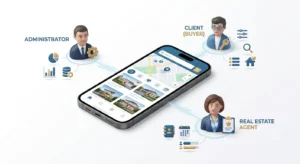
Important capabilities include a content management system, analytics dashboard, user management, property moderation, advertisement management, CRM integration, and role-based permissions.
A feature matrix can help define responsibilities clearly:
| Capability | Buyer/
Tenant | Agent | Admin |
|---|
| Search properties | Yes | Yes | Yes |
| Save favorites | Yes | Yes | No |
| Manage listings | No | Yes | Yes |
| Manage leads | No | Yes | Yes |
| Schedule appointments | Yes | Yes | Yes |
| Manage users | No | Limited | Yes |
| Analytics | Personal | Sales | Full platform |
| Property moderation | No | No | Yes |
A mobile app can significantly improve property discovery, customer engagement, and communication, but it should be part of a broader digital transformation strategy. Real estate businesses can combine mobile technology with AI, automation, cloud platforms, CRM, and data analytics to create more connected and efficient operations. Explore our Digital Transformation Real Estate Roadmap to understand how to plan and implement a comprehensive digital transformation strategy.

Advanced Features That Differentiate Modern Property Apps
Basic listings and search are no longer enough for businesses looking to build a more competitive real estate mobile application.
AI Property Recommendations
AI can analyze searches, saved properties, clicks, location preferences, budget, and other user behavior to recommend relevant properties. More relevant recommendations can reduce search time and increase the likelihood of inquiries.
AI-Powered Property Matching
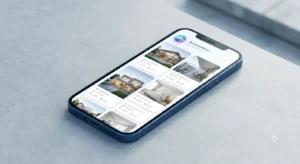
Instead of relying only on filters, an AI matching engine can compare buyer preferences with property attributes and rank suitable options.
AI Lead Qualification
AI can evaluate incoming leads based on factors such as budget, preferred location, property type, engagement, and purchase intent. Agents can then prioritize leads that are more likely to convert.
AI Chat Assistants
An AI assistant can answer property-related questions, recommend listings, help schedule appointments, and guide users through common processes. This gives customers immediate support without requiring an agent to answer every basic query.
Virtual Tours and Video Walkthroughs
360-degree virtual tours allow prospective buyers and tenants to explore properties remotely. Video walkthroughs provide another engaging way to present properties, particularly when customers cannot visit immediately.
AR Property Visualization
Augmented reality can help users visualize furniture placement, room layouts, or potential interior changes. For developers, it can also provide an interactive way to showcase properties that are still under construction.
Voice Search
Voice-based search can make property discovery more convenient. Users could search for properties using natural language rather than entering multiple filters manually.
OCR and Digital Document Processing
OCR technology can extract information from identity documents, agreements, and other paperwork. Combined with digital verification, this can reduce manual data entry and speed up property-related processes.
Electronic Signatures
Electronic signatures can make agreements and approvals easier to complete remotely while reducing reliance on physical paperwork.
Smart Notifications and Personalized Dashboards
Instead of sending generic notifications, the application can provide updates based on each user’s interests and activity. Personalized dashboards can display relevant properties, appointments, recommendations, saved searches, and recent activity.
Integrating Your Mobile App With Existing Business Systems
A property app should not operate as an isolated system.
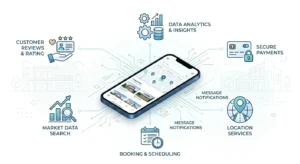 CRM integration can automatically transfer inquiries into the sales pipeline. ERP integration can connect property operations, finance, accounting, inventory, or other business processes.
Depending on the market and business model, MLS or property listing integrations can synchronize property information.
Payment gateway integration supports online deposits, rent payments, booking fees, or other transactions. Maps and geolocation APIs enable location search, navigation, and nearby amenity discovery.
Marketing automation and email platforms can support lead nurturing. WhatsApp integration can provide another communication channel for customers and agents. Calendar integration can simplify appointment scheduling.
Analytics platforms can provide insights into searches, property views, conversions, user retention, and campaign performance.
This connected approach helps turn the mobile application into part of the company’s broader digital infrastructure.
Choosing the Right Technology Stack
Technology selection should depend on the app’s functionality, expected user base, performance requirements, budget, and long-term roadmap.
| Technology Approach | Advantages | Considerations |
|---|
| Native iOS and Android | Strong performance, platform-specific optimization, and access to device capabilities | Higher development cost when building separate applications |
| Flutter | Single codebase, fast development, and consistent UI | Some platform-specific requirements may need additional native development |
| React Native | Cross-platform development and a broad ecosystem | Certain advanced native features may require native modules |
Native development using technologies such as Swift for iOS and Kotlin for Android can be suitable for applications requiring highly platform-specific functionality.
Cross-platform frameworks such as Flutter and React Native can be practical for businesses looking to launch across platforms while controlling development time and costs.
The backend can be built using technologies suited to the application’s requirements, while cloud hosting can provide scalability as traffic and data volumes increase.
Technology decisions should also account for API architecture, database performance, cloud infrastructure, monitoring, security, and future integrations.
A real estate mobile app can become even more effective when connected with core business systems such as CRM and ERP. While CRM focuses on managing leads, customer relationships, and sales activities, ERP supports broader business operations such as finance, property management, and resource planning. Learn more about Real Estate CRM vs ERP to understand which system best supports different real estate business needs.
Security Features Every Property App Needs
Real estate applications can handle personal information, identity documents, payment data, property records, and business information. Security therefore needs to be considered from the beginning.
Important security measures include:
- Secure authentication and session management
- Role-based access controls
- Encryption for sensitive data
- Secure payment processing
- API authentication and protection
- Privacy and applicable data protection compliance
- Regular backups
- Disaster recovery planning
- Cloud security controls
- Monitoring and vulnerability testing
Security should not be treated as a feature added immediately before launch. It needs to be incorporated throughout real estate software development.
How AI Is Transforming Real Estate Mobile Apps
AI is changing how property businesses handle both customer-facing and internal processes.
AI-powered recommendations can connect users with relevant properties faster. Intelligent search can interpret natural language queries instead of requiring users to select multiple filters.
Predictive buyer matching can help agents identify promising opportunities. AI lead scoring can prioritize prospects for sales teams.
Document extraction can reduce manual data entry, while AI chatbots can support users throughout the property discovery process rather than simply answering frequently asked questions.
For property managers, AI can also support predictive maintenance by identifying patterns in maintenance requests and property data.
AI analytics can help brokers identify trends in customer behavior, property demand, lead quality, and sales performance.
The business value goes beyond automation. When AI helps customers find suitable properties faster and gives agents better-quality leads, it can contribute directly to improved conversion rates, sales productivity, and customer satisfaction.
How to Plan Your Real Estate App Development Project
Successful custom real estate app development starts with planning rather than coding.
Begin by defining the business objectives. Are you trying to generate more leads, increase property bookings, improve tenant services, help agents close deals faster, or create a new property marketplace?
Next, identify your user personas and map their key journeys.
Define the MVP around the features that directly support your primary objective. For a property marketplace, this might include registration, listings, search, filters, favorites, maps, inquiries, and notifications. For a property management platform, the priorities may be tenant communication, maintenance requests, documents, and payments.
Budget planning should account for design, development, integrations, testing, deployment, security, hosting, and ongoing maintenance.
UX planning should focus on simple navigation and fast property discovery. Integrations should be identified before development begins because they can influence the application architecture.
Thorough testing should cover functionality, performance, security, compatibility, and usability.
After launch, monitor analytics and user feedback to determine which features should be improved or added.
Why Businesses Choose Custom Real Estate Mobile Apps
Off-the-shelf platforms can provide useful functionality, but they may not match every property company’s processes.
Custom development allows businesses to create workflows around their actual operations. It provides greater flexibility for CRM and ERP integration, unique customer journeys, specialized property types, and future product development.
A custom application can also help a business differentiate itself instead of offering customers the same experience as competitors using the same platform.
With ownership of the application and intellectual property, businesses can continue evolving the product as their requirements change.
The long-term value of custom real estate software development comes from combining a better customer experience with operational efficiency, integration flexibility, scalability, and control.

Conclusion
Real estate mobile app development is no longer simply about creating a digital property catalogue. The strongest applications connect property discovery, customer engagement, sales, communication, payments, documentation, and property management in one convenient experience.
The right real estate app features will depend on your business model and users. Core functionality such as property listings, search, maps, favorites, messaging, lead management, and analytics provides the foundation. Advanced capabilities such as AI recommendations, virtual tours, intelligent search, document processing, and predictive analytics can create additional value as the platform grows.
The key is to build around clear business objectives rather than adding every available feature. With the right technology, integrations, security architecture, and development strategy, a real estate mobile application can become a long-term digital asset for property businesses.
Frequently Asked Questions
How much does it cost to develop a real estate mobile app?
The cost depends on the app’s complexity, number of platforms, UI requirements, integrations, security requirements, and advanced features such as AI, virtual tours, or digital payments. A focused MVP generally costs less than a full-featured property platform.
How long does it take to build a property app?
Development time depends on the scope and complexity of the application. A basic MVP can be developed faster than a platform involving multiple user roles, CRM and ERP integrations, payments, AI, and advanced property management features.
What features should be included in an MVP for a real estate app?
An MVP can include user registration, property listings, search and filters, property details, image galleries, maps, favorites, inquiries, agent communication, notifications, and an admin dashboard. The exact feature set should be based on the business objective.
Can a real estate app integrate with CRM and ERP systems?
Yes. A properly designed application can integrate with CRM, ERP, payment gateways, marketing automation platforms, calendars, analytics tools, document management systems, and other business applications through APIs and integration services.
How can AI improve a real estate mobile application?
AI can provide personalized property recommendations, intelligent search, buyer and property matching, lead scoring, AI chat assistance, document extraction, predictive analytics, and personalized notifications. These capabilities can improve customer experience and help sales teams prioritize opportunities.
How do I choose the right real estate app development company?
Look for experience in mobile development, real estate software, API integrations, security, cloud technologies, and ongoing application support. Review previous projects and ask how the company approaches discovery, UX design, development, testing, deployment, and maintenance.
Should I build a native or cross-platform real estate app?
Both approaches can work. Native development may be preferable when an application requires extensive platform-specific capabilities. Flutter or React Native can be suitable when a business wants to build for multiple platforms using a shared codebase.
Can a real estate app support multiple user roles?
Yes. Role-based access can provide different interfaces and permissions for buyers, tenants, agents, property managers, administrators, owners, and other users. This helps each user access only the features and information relevant to their role.
Why is custom real estate app development better than an off-the-shelf platform?
Custom development gives businesses greater control over functionality, integrations, workflows, branding, scalability, and future enhancements. It can be particularly valuable when standard platforms cannot support specific business processes or customer requirements.