Key Highlights
- Digital transformation in real estate helps businesses improve efficiency, customer experience, and profitability.
- Developers, brokers, and property managers have different digital priorities but share common business goals.
- Assessing digital maturity before investing in technology leads to better implementation success.
- ERP, CRM, AI, cloud platforms, and automation create a connected real estate ecosystem.
- A phased digital transformation roadmap reduces risks and maximizes ROI.
- AI supports smarter decision-making through predictive analytics, lead scoring, pricing, and maintenance insights.
- Success should be measured using KPIs such as lead conversion, occupancy, operational efficiency, and customer satisfaction.
Why Digital Transformation Is Reshaping Real Estate
The real estate industry has experienced significant changes over the last decade. Buyers expect instant property information, online bookings, virtual tours, digital documentation, and seamless communication throughout their buying or renting journey. At the same time, developers and property managers must handle growing project complexities, regulatory compliance, and rising customer expectations.
This shift has made digital transformation in real estate a business necessity rather than an optional technology upgrade.
Instead of relying on spreadsheets, paperwork, and disconnected software, organizations are adopting integrated digital platforms that connect sales, finance, operations, customer service, and property management into one ecosystem.
The benefits extend to every stakeholder:
- Faster project execution
- Better customer engagement
- Improved operational visibility
- Data-driven decision-making
- Lower operational costs
- Increased business scalability
Digital transformation is no longer an IT initiative. It has become a strategic business approach that directly influences revenue, customer satisfaction, and long-term growth.
What Digital Transformation Means for Developers, Brokers, and Property Managers
Every business within the real estate industry has unique operational requirements. Their transformation journey also differs.
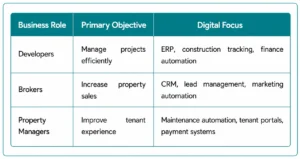
Although their priorities differ, all three groups share common goals:
- Better customer experience
- Faster communication
- Higher operational efficiency
- Improved financial visibility
- Data-driven decision making
- Business scalability
Successful real estate digital transformation aligns technology investments with these business objectives instead of purchasing software without a clear strategy.
Common Challenges That Slow Digital Transformation
Many organizations recognize the need for digital transformation but struggle during implementation because their existing processes remain heavily manual.
Common business challenges include:
- Paper-based documentation
- Inefficient lead management
- Poor project visibility
- Delayed maintenance requests
- Slow tenant communication
- Disconnected accounting systems
- Duplicate data entry
- Limited business reporting
- Slow decision-making
These problems create bottlenecks across the entire business lifecycle.
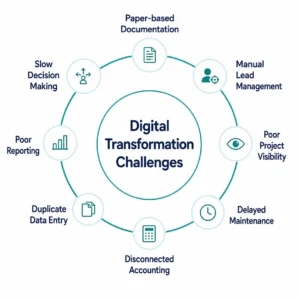
For example, a sales team may capture leads through multiple channels, but without an integrated CRM, follow-ups become inconsistent. Similarly, property managers using separate maintenance and accounting systems often experience delayed responses and incomplete financial records.
Assess Your Digital Maturity Before Investing
Before investing in new technology, businesses should evaluate their current digital capabilities.
Ask the following questions:
- Are critical processes still manual?
- Can departments access the same data?
- Is customer information centralized?
- Can managers generate reports instantly?
- Are approvals automated?
- Can employees work remotely?
- Are customers receiving a consistent experience?
Digital Maturity Scorecard
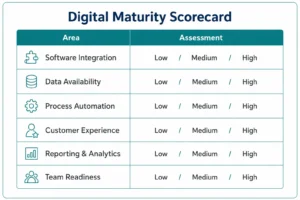
Understanding your current position helps prioritize investments and reduces implementation risks.
Digital Readiness Checklist
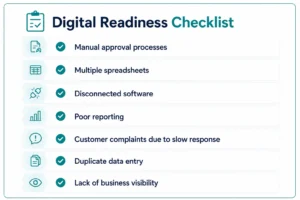
If several of these challenges exist, your organization is ready to begin its digital transformation journey.
A Practical Digital Transformation Roadmap
A successful transformation should happen in phases rather than all at once.
Phase 1: Assess Existing Processes
Identify manual workflows, operational bottlenecks, and customer pain points.
Phase 2: Define Business Objectives
Set measurable goals such as reducing project delays, improving lead conversion, or increasing occupancy rates.
Phase 3: Prioritize Quick Wins
Automate repetitive tasks that provide immediate value, including document approvals, payment reminders, and CRM workflows.
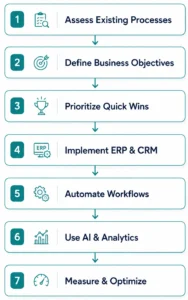
Phase 4: Implement ERP and CRM
An integrated ERP and CRM become the foundation of your digital ecosystem by connecting finance, projects, sales, procurement, and customer management.
Phase 5: Automate Workflows
Introduce workflow automation for approvals, maintenance requests, notifications, invoicing, and customer communication.
Phase 6: Use AI and Analytics
Leverage predictive analytics, forecasting, smart recommendations, and AI-powered reporting for better business decisions.
Phase 7: Measure and Optimize
Track KPIs regularly and continuously refine processes based on performance insights.
Technologies Powering Digital Transformation
Modern real estate software solutions work best when integrated into one connected platform rather than operating independently.
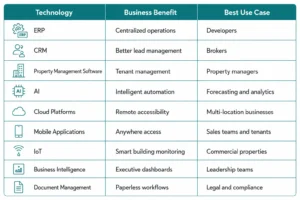
When these technologies communicate seamlessly, businesses eliminate duplicate work and gain complete operational visibility.
AI Is Changing Real Estate Beyond Chatbots
Artificial Intelligence has moved far beyond answering customer queries. Today, AI supports every stage of the real estate lifecycle.
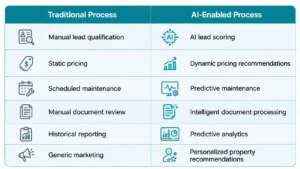
Practical AI applications include:
- Lead qualification based on buyer behavior
- Predicting property demand
- Forecasting project completion risks
- Identifying maintenance issues before failures occur
- Automated document verification
- Smart pricing recommendations
- Sales forecasting
- Personalized customer journeys
Rather than replacing employees, AI enables teams to make faster and more informed decisions.
KPIs to Measure Digital Transformation Success
Technology investments should deliver measurable business improvements.
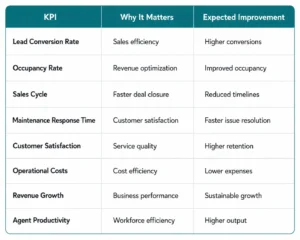
Tracking these KPIs helps organizations evaluate ROI and continuously optimize operations.
Common Mistakes to Avoid
Many digital transformation initiatives fail because businesses focus on technology instead of processes.
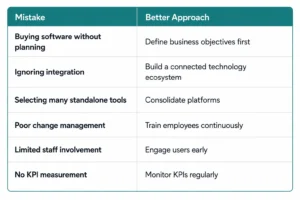
Successful transformation requires leadership commitment, employee adoption, and continuous improvement.
Digital transformation doesn’t end with implementing ERP or automating workflows. Many trading and distribution companies are now using AI to make faster, data-driven decisions across their supply chains. Explore our guide on AI for inventory forecasting in distribution businesses to discover how predictive analytics can improve inventory accuracy, reduce carrying costs, and support sustainable business growth.
Choosing the Right Digital Transformation Partner
Technology alone cannot transform a business. The right implementation partner makes the difference.
Look for a partner that offers:
- Industry expertise
- Digital transformation consulting
- ERP implementation
- CRM customization
- AI integration
- Cloud migration
- Custom software development
- Mobile application development
- Ongoing support and optimization
A strategic technology partner understands business challenges before recommending solutions.
Why Real Estate Businesses Choose Webtree
The future of real estate belongs to businesses that embrace technology as a strategic advantage. Whether you are a developer managing large construction projects, a broker handling customer relationships, or a property manager overseeing multiple assets, digital transformation creates opportunities to improve efficiency, reduce costs, and deliver exceptional customer experiences.
By assessing your digital maturity, implementing technology in phases, integrating ERP and CRM systems, leveraging AI, and measuring meaningful business outcomes, you can build a resilient and future-ready organization.
With the right roadmap and technology partner, digital transformation becomes a long-term investment that supports sustainable growth and competitive advantage.
At Webtree, digital transformation begins with understanding your business processes, identifying operational gaps, and designing solutions that align with your growth objectives.
Our solutions include:
- Digital transformation consulting
- ERP implementation
- CRM development
- Custom real estate software solutions
- AI-powered automation
- Property management platforms
- Mobile and web application development
- Cloud-based business solutions
- Long-term support and optimization
Instead of offering one-size-fits-all software, Webtree develops scalable digital solutions that improve efficiency, enhance customer experiences, and prepare businesses for future growth.
 Frequently Asked Questions
What is digital transformation in real estate?
Digital transformation in real estate involves using technologies such as ERP, CRM, AI, cloud computing, and automation to improve business operations, customer experiences, and decision-making.
Why is digital transformation important for property management?
Digital transformation for property management helps automate maintenance requests, tenant communication, rent collection, reporting, and operational workflows, resulting in improved efficiency and tenant satisfaction.
What software is essential for real estate digital transformation?
Essential solutions include ERP systems, CRM platforms, property management software, document management systems, business intelligence tools, cloud platforms, AI-powered analytics, and mobile applications.
How does AI benefitreal estate businesses?
AI helps qualify leads, forecast demand, optimize pricing, automate document processing, predict maintenance needs, improve customer engagement, and generate actionable business insights.
How long does a digital transformation project take?
The timeline depends on the organization’s size, existing systems, and business goals. Most projects are implemented in phases over several months to ensure smooth adoption and measurable results.