| Traditional Valuation | AI-Based Valuation |
|---|
| Manual research | Automated analysis |
| Limited comparable properties | Thousands of comparable properties |
| Time consuming | Instant valuation |
| Subjective estimates | Data-driven pricing |
| Periodic updates | Continuous market monitoring |
Predictive Market Intelligence for Developers
Before investing millions into a project, developers need confidence that demand will exist.
AI for real estate developers supports project planning through predictive analytics.
AI can evaluate:
- Population growth
- Infrastructure development
- Consumer purchasing behavior
- Rental demand
- Employment trends
- Future investment opportunities
These insights help developers determine:
- Where to build
- Which property types are likely to perform well
- Optimal pricing strategies
- Expected occupancy rates
Instead of reacting to market changes, developers can make proactive investment decisions.
AI for Lead Generation and Qualification
Every property inquiry is valuable, but not every inquiry becomes a customer.
AI helps sales teams focus on high-quality prospects.
Modern AI systems can:
- Operate chatbots 24/7
- Detect customer intent
- Analyze budgets
- Score leads
- Schedule appointments
- Trigger automated follow-ups

Personalized Property Recommendations
Today’s buyers expect personalized experiences similar to those offered by streaming and eCommerce platforms.
AI recommendation engines analyze:
- Search history
- Budget
- Preferred locations
- Lifestyle preferences
- Family size
- Previous interactions
Instead of showing hundreds of listings, AI recommends properties most likely to match customer preferences, improving customer satisfaction while shortening the buying journey.
AI for Document Processing and Compliance
Real estate involves extensive documentation, including:
- Lease agreements
- Purchase contracts
- Identity verification
- Financial documents
- Compliance reports
Generative AI significantly reduces administrative workloads.
AI can automatically:
- Extract information using OCR
- Summarize lengthy contracts
- Detect missing fields
- Verify tenant documents
- Identify fraudulent payslips
- Flag compliance issues
Instead of manually reviewing hundreds of pages, legal and administrative teams can focus on complex cases requiring human expertise.
Predictive Maintenance for Property Managers
Maintenance is one of the most important applications of AI for property management. Smart buildings equipped with IoT sensors continuously monitor equipment performance.
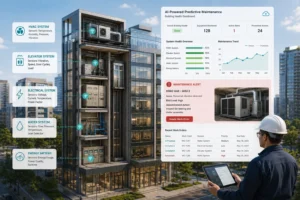
AI analyzes data from:
- HVAC systems
- Water pipelines
- Electrical equipment
- Elevators
- Energy meters
Typical process:
Building Sensors → AI Analysis → Maintenance Alert → Technician
Rather than waiting for failures, AI predicts maintenance requirements before breakdowns occur.
Benefits include:
- Reduced downtime
- Lower repair costs
- Increased equipment lifespan
- Better tenant satisfaction
AI-Based Work Order Automation
Property managers often receive maintenance requests through multiple channels.
AI automatically:
- Categorizes requests
- Detects urgency
- Assigns vendors
- Prioritizes tickets
- Monitors service-level agreements
- Tracks completion
This reduces response times and improves operational efficiency.
AI in Customer Experience
Customer service is becoming increasingly digital.
Virtual AI assistants now help customers:
- Book property visits
- Receive instant answers
- Track maintenance requests
- Schedule appointments
- Get personalized recommendations
AI enables real estate businesses to provide consistent support around the clock while reducing operational costs.
AI for Sales Forecasting
Sales forecasting is no longer based solely on historical reports.
AI evaluates:
- Sales pipeline
- Customer engagement
- Marketing campaigns
- Market conditions
- Seasonal demand
This helps businesses predict revenue, improve inventory planning, and optimize marketing investments.
AI for Portfolio and Asset Management
For organizations managing multiple properties, AI provides a centralized view of portfolio performance.
AI supports:
- Occupancy prediction
- Rental optimization
- Asset performance analysis
- Risk identification
- Capital planning
These insights help investors maximize returns while minimizing operational risks.
AI can deliver significant value across real estate, but successful adoption requires more than implementing individual AI tools. It should be aligned with a broader digital transformation strategy that connects technology, processes, data, and customer experience. Explore our Digital Transformation Real Estate Roadmap to understand how real estate businesses can plan and implement transformation in a structured way.
AI + IoT + ERP: Building an Intelligent Real Estate Business
AI becomes even more powerful when integrated with ERP, CRM, IoT, and property management platforms.

Instead of isolated software systems, organizations create a connected digital ecosystem where information flows automatically between departments.
An integrated platform enables:
- Unified customer records
- Automated financial reporting
- Smart maintenance scheduling
- Sales forecasting
- Inventory management
- Business intelligence dashboards
Conceptually:
ERP + CRM + IoT + AI → Unified Real Estate Platform
This connected approach eliminates data silos and provides leadership teams with a complete view of business performance.
For organizations pursuing digital transformation, integration often delivers greater long-term ROI than implementing standalone AI tools.
Challenges Businesses Should Consider Before Adopting AI
Successful AI implementation requires careful planning.
Some common challenges include:
- Poor data quality
- Legacy software systems
- Employee resistance to change
- Data privacy and security
- AI governance policies
- Integration complexity
- Unrealistic ROI expectations
How to Successfully Implement AI in Real Estate
Many businesses make the mistake of adopting AI before identifying the problems they want to solve.

A successful implementation roadmap includes:
1. IdentifyBusiness Challenges
Focus on operational bottlenecks, customer experience gaps, or repetitive manual tasks.
2. Prioritize High-Impact Use Cases
Start with applications such as lead qualification, predictive maintenance, or document automation.
3. Prepare High-Quality Data
AI performs best when trained on clean, consistent, and accurate business data.
4. Integrate Existing Systems
Connect AI with ERP, CRM, accounting software, and property management platforms.
5. Launch Pilot Projects
Test AI within a limited department before expanding organization-wide.
6. Measure Performance
Track KPIs such as response time, conversion rate, maintenance costs, and operational efficiency.
7. Scale Gradually
Expand successful AI initiatives across departments while continuously refining models and workflows. This structured approach minimizes implementation risks and maximizes long-term business value.

Why Businesses Choose Webtree for AI-Powered Real Estate Solutions
Technology implementation requires more than simply deploying AI tools. Businesses need solutions that integrate seamlessly with existing systems and support long-term growth.
Webtree partners with developers, brokers, and property managers to design intelligent digital ecosystems tailored to their business goals.
Our expertise includes:
- AI consulting and strategy
- Custom AI application development
- ERP implementation
- CRM integration
- Property management software
- Cloud solutions
- Business intelligence dashboards
- End-to-end digital transformation
By combining AI with enterprise software, automation, and analytics, Webtree helps real estate businesses improve efficiency, enhance customer experiences, and make smarter decisions with confidence.
Frequently Asked Questions
Can small real estate agencies benefit from AI?
Yes. AI-powered tools such as chatbots, lead scoring, document automation, and personalized property recommendations help small agencies improve efficiency and customer service without requiring enterprise-level budgets.
Does AI replace real estate agents?
No. AI automates repetitive tasks and provides valuable insights, allowing agents to focus on relationship building, negotiations, and delivering personalized client experiences.
What data does AI use to estimate property values?
AI analyzes historical sales data, neighborhood trends, tax records, property features, local market demand, comparable sales, and demographic information to generate accurate valuations.
How does AI improve property management?
AI enables predictive maintenance, automates work order routing, monitors building performance through IoT sensors, reduces maintenance costs, and improves tenant satisfaction.
Can AI integrate with existing ERP or CRM systems?
Yes. Modern AI solutions integrate with ERP, CRM, property management software, and business intelligence platforms to create a connected and efficient business ecosystem.
How is AI used in commercial real estate?
AI in commercial real estate supports lease management, occupancy forecasting, predictive maintenance, investment analysis, energy optimization, and portfolio performance monitoring.
Is AI secure for handling real estate documents?
Yes, when implemented with proper encryption, access controls, compliance standards, and governance policies, AI can securely process contracts, leases, and customer records.
How can Webtree help implement AI in real estate?
Webtree provides AI consulting, custom application development, ERP and CRM integration, cloud solutions, business intelligence dashboards, and end-to-end digital transformation services tailored to the real estate industry.