Key Highlights
- Real estate CRM software focuses on leads, customer relationships, sales pipelines, and communication, while ERP manages finance, projects, procurement, inventory, and compliance.
- CRM and ERP are complementary systems that can work together across the complete property lifecycle.
- An integrated real estate CRM and ERP platform creates a single source of truth and reduces duplicate data entry.
- Connected systems can improve sales efficiency, project tracking, financial reporting, inventory visibility, and customer service.
- Growing developers, builders, property management companies, commercial property firms, and brokerages can benefit from integrated real estate management software.
- The right implementation partner should offer industry expertise, integration capabilities, custom development, security, scalability, and long term support.
Why Connected Systems Are Transforming Real Estate
Real estate businesses manage several functions at the same time. Sales teams handle leads and property inquiries, project teams monitor construction, finance teams manage payments and budgets, while management needs accurate reports to make business decisions.
When these departments rely on disconnected software, spreadsheets, or manually updated records, information can quickly become difficult to manage. Teams may enter the same customer information more than once, sales teams may not have access to the latest project information, and management reports can take longer to prepare.
This is where real estate CRM and ERP systems can work together.
A CRM manages customer facing activities, while an ERP connects core business operations. When integrated, the two systems allow information to move between departments instead of remaining in separate databases.
The result is a more connected property business where sales, construction, finance, procurement, inventory, and customer service can work from consistent information.
What Is a Real Estate CRM?
A real estate CRM, or customer relationship management system, is designed to manage interactions with prospects, customers, brokers, and channel partners.
A typical real estate CRM software platform can capture leads from property portals, websites, social media, digital advertising, and other sources. Once a lead enters the system, sales teams can qualify the prospect, schedule site visits, track proposals, manage bookings, and follow up with customers.
Real estate CRM systems can also support marketing and communication through email, SMS, and WhatsApp automation. They can help sales teams track conversations, manage follow ups, monitor sales pipelines, and manage broker commissions.
For property businesses, the CRM therefore becomes the main system for managing the customer journey.
What Is a Real Estate ERP?
A real estate ERP focuses on the operational and administrative side of the business.
Unlike software that only handles accounting, real estate ERP software can connect financial management with project management, procurement, inventory, vendors, compliance, and other business processes.
Depending on business requirements, an ERP may support financial accounting, GST and TDS management, multi company accounting, RERA tracking, construction project management, budget monitoring, engineering workflows, property inventory, purchase orders, and vendor billing.
For example, a property developer may need to monitor project budgets while also tracking construction activities, purchases, vendor invoices, and available property units. An ERP can bring these activities into a connected operational system.
This makes ERP an important part of real estate management software for businesses managing complex projects and multiple departments.
CRM vs ERP for Real Estate: What’s the Difference?
CRM and ERP serve different purposes, but they are not competing technologies.
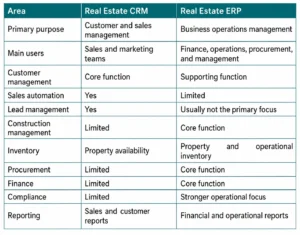
The simplest way to look at it is this: CRM manages the relationship with the customer, while ERP manages the business behind the relationship.
For many growing property businesses, using both together can provide greater value than relying on either system alone. 
How CRM and ERP Work Together
The real value of CRM and ERP becomes clearer when you look at the complete property lifecycle.
A customer may first submit an inquiry through a website or property portal. The CRM captures the lead and helps the sales team qualify it. The customer is then invited for a site visit and moves through the sales pipeline.
Once the customer makes a booking, relevant information can move from the CRM into the ERP. The ERP can then support project allocation, construction updates, financial processes, and other operational activities.
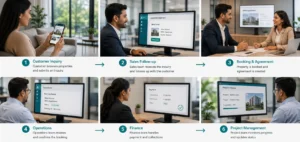 Without integration, employees may have to enter the same information into different systems. With an integrated platform, customer and project information can flow between systems more efficiently.
This can also help customer service teams provide more accurate updates because information about bookings, projects, payments, and other relevant activities is easier to access.
CRM and ERP are important components of a broader digital transformation strategy for real estate businesses. If you want to understand how to plan transformation across technology, processes, data, and operations, explore our Digital Transformation in Real Estate: A Practical Roadmap for Developers, Brokers, and Property Managers.
Benefits of an Integrated CRM and ERP Platform
- A Single Source of Truth
An integrated platform can bring customer, sales, project, financial, and operational information together. Teams can work with consistent data rather than maintaining separate records.
- Better Customer Experience
Customers expect timely and accurate responses. When sales and operations have access to connected information, teams can respond faster and provide more reliable updates.
- Faster Sales Cycles
Automated lead capture, follow ups, site visit scheduling, proposals, bookings, and communication can reduce manual work for sales teams.

- Improved Reporting
Management can gain a broader view of sales performance, project progress, finances, inventory, and other business activities through unified reporting and dashboards.
- Better Property Inventory Visibility
An integrated system can connect sales activity with property availability, helping teams maintain better visibility of units and bookings.
- Improved Project Tracking
ERP functionality can support construction workflows, budget monitoring, engineering processes, procurement, and other project activities.
- More Accurate Financial Management
When operational information connects with finance, businesses can improve visibility into budgets, billing, payments, and financial reporting.
- Higher Employee Productivity
Automation and connected workflows reduce repetitive data entry and help employees spend less time moving information between systems.
Choosing between a ready-made platform and a custom solution is another important consideration when modernizing real estate operations. Learn more about the differences in our guide to Custom Real Estate Software vs. Off-the-Shelf Solutions.
When Does Your Business Need Both CRM and ERP?
Not every small property business needs a complex integrated platform from day one. However, the need often becomes clearer as operations grow.
Developers, builders, commercial property firms, property management companies, multi location agencies, growing brokerages, and businesses managing mixed use developments can benefit from connecting customer facing and operational systems.
Consider a business where the sales team uses one CRM, finance relies on spreadsheets, and the construction team maintains separate project records. If employees repeatedly enter the same information or struggle to obtain current project and customer data, integration may be worth considering.
The key question is not simply whether your business needs more software. It is whether your existing systems allow information to move efficiently across the business.
Separate Systems or an Integrated Platform?
Businesses can choose between separate commercial CRM and ERP platforms, custom integrations, or a more unified solution.
Off the shelf software can be useful when standard workflows match the business. Custom integrations can make separate platforms work together, while custom dashboards can provide unified reporting.
The right approach depends on several factors:
- Cost
- Business workflow
- Flexibility
- Ownership
- Integration requirements
- Scalability
- Future AI readiness
A business should also consider how its requirements may change over time. The solution that works for a smaller operation may become restrictive as the company adds projects, locations, users, or business functions.
Common Implementation Challenges and How to Avoid Them
Implementing integrated real estate software involves more than connecting two applications. Businesses should prepare for common challenges such as data migration, user adoption, legacy software, duplicate records, poor integrations, change management, and inconsistent reporting.
Before implementation, businesses should identify which data needs to move between systems and which processes need automation.

Employee involvement is also important. Teams should understand how the new system changes their daily workflows and how it helps them complete tasks more efficiently.
A clear implementation plan can help businesses reduce disruption and improve adoption.
Choosing the Right CRM and ERP Partner
Choosing the right technology is only one part of the process. The implementation partner can have an equally important role.
When evaluating a technology partner, consider:
- Real estate industry expertise
- CRM and ERP integration capability
- Custom software development
- ERP consulting
- CRM consulting
- Cloud deployment
- AI readiness
- Security
- Scalability
- Long term technical support
A strong partner should understand your business processes before recommending a technical solution. Instead of simply supplying software, the partner should help connect processes across sales, operations, finance, projects, and customer service.
Why Real Estate Businesses Choose Webtree
Webtree approaches real estate technology as a digital transformation project rather than simply a software purchase.
Its capabilities include real estate software consulting, custom CRM development, ERP implementation, property management software, mobile applications, AI integration, cloud solutions, API integrations, analytics dashboards, and long term support.
This approach can help businesses create connected digital platforms around their existing workflows and future growth plans.
Frequently Asked Questions
What is the difference between CRM and ERP in real estate?
A CRM manages customer relationships, leads, sales pipelines, and communication. An ERP handles business operations such as finance, project management, procurement, inventory, and compliance.
Do real estate companies need both CRM and ERP?
Businesses with growing operations, multiple departments, or complex projects can benefit from using both systems together. The combination helps connect sales and customer activities with back office operations.
Can CRM and ERP be integrated?
Yes. CRM and ERP systems can be integrated to share relevant customer, project, financial, and inventory information, creating a more unified view across the organization.
Which businesses benefit most from integrated CRM and ERP?
Property developers, builders, commercial real estate firms, property management companies, and multi location brokerages can gain significant value from integrated platforms.
Should I choose separate software or a custom integrated solution?
The right option depends on your business size, workflow complexity, budget, and growth plans. Some organizations use commercial CRM and ERP platforms with custom integrations, while others require a more customized solution.
How does CRM and ERP integration improve customer experience?
Integration can reduce duplicate data entry, support faster responses, provide better project updates, improve communication, and create a smoother experience from initial inquiry through property handover.
Can an integrated platform support property management and construction?
Yes. An ERP can support areas such as project management, budget monitoring, procurement, engineering workflows, property inventory, and vendor billing, while the CRM manages customer and sales activities.
What should I look for in a real estate CRM and ERP partner?
Look for real estate industry experience, integration capabilities, custom development expertise, security, scalability, cloud solutions, AI readiness, consulting capabilities, and long term support.