Key Takeaways
- A successful startup begins with validating the problem before writing code.
- Building an MVP helps reduce costs and gather real user feedback.
- Choosing the right technology stack impacts scalability and long-term growth.
- Outsourcing software development can accelerate product launches while optimizing budgets.
- Planning for scalability from day one prevents costly rebuilds later.
Building a successful startup requires more than a great idea. Startups need to work themselves up in a highly volatile environment. The chances of failure or inability to launch are far greater than in businesses that have been in the market for the long run. That is why software product development for startups requires a proven guide ensuring the transformation of innovative ideas into scalable solutions, while minimizing risks.
Without the right software development strategy, startups often face budget overruns, delayed launches, and scalability issues. Understanding the startup software development process helps founders validate ideas, build MVPs, and launch products that can grow with their business.
Best Practices in Custom Software Development For Startups
Many successful startups have demonstrated that an imperfect first product is not necessarily a sign of failure. If startups can immediately focus on user value and tweak outcomes, they can garner success and remain relevant in a competitive environment.
Following best practices in startup app development can eliminate the risks of developing a non-viable product. Partnering with a reliable technology partner like Webtree Software Solutions can help startup companies develop and launch successful software products.
At Webtree Software Solutions, we help startups navigate the software product development journey with a structured, step-by-step approach, enabling them to focus on building, testing, and launching their products with confidence.
Idea Validation and Market Research Before Software Development
One of the foundation steps in the startup software development process is to define the problem and understand the pain points your product intends to resolve. It is important to analyze competitor products for a better understanding and to identify gaps.
During this stage, it is essential to talk directly to your target audience, gauging market trends and minimum viable segments in your audience.
Designing a Minimum Viable Product ( MVP Development)
After your initial market research, it is important that you do not focus on trying to develop an “over-the-top” product that surpasses software development costs for startups and extends development timelines. Instead, prioritize building a minimum viable product (MVP) that addresses core customer needs, validates your concept, and allows for continuous improvements based on real user feedback.
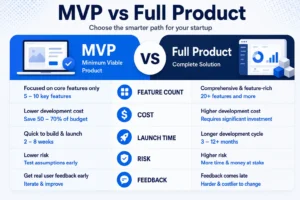
When it comes to MVP Vs full scale product development, choose an MVP for faster market validation, lower development costs, reduced risk, and the opportunity to refine your product based on real user feedback before committing to a larger investment.
Further, prioritize core features only and focus on UX/UI design that is simple and user-friendly with no complicated tools.
Choosing the Right Technology Stack for Startup Software Development
A tech stack in software development is the combination of programming languages, databases, and servers required to develop and run a software application.
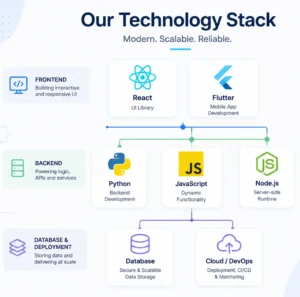
For startups, it is important to choose a reliable tech stack without depending on complex frameworks that make hiring developers difficult. Opt for standard technology such as Python, JavaScript and Flutter to ensure easy navigation throughout the software product development.
Build a Cross-Functional Software Development Team.
Software app development involves various elements that require specialized skills. Startup companies must build a proactive and cross-functional team to handle the various aspects of software development.
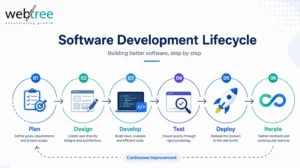
From quality testing teams to designers and product leaders, these experts must essentially be an integral part of the startup software development process.
Webtree Software Solutions has a team of highly experienced technology experts providing expertise on software app development and MVP deployment services for startup software solutions.
Implement Continuous Testing
The startup software development process must essentially include continuous testing to help developers adjust project roadmaps accordingly.
📖 Also Read
Successful digital products begin with the right foundation. Learn how software development consulting enables organizations to validate ideas, select the appropriate technology stack, and minimize risks before investing in full-scale development.
→ Software Development Consulting: Process, Benefits & Guide
Common Software Development Mistakes Startups Should Avoid
Startup software development companies often fail for the following reasons:
- Improper project planning
- Product-related mishaps, such as poor architecture
- Hiring cheap freelancers who lack proper skills
- No testing and Quality checks
- Choosing technology based on trends
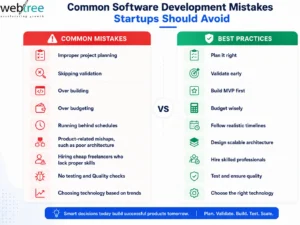
Partnering with experienced developers from Webtree Software Solutions for startup software development ensures proper project planning, minimizing the risk of project failures. Outsourcing software development allows startups to scale their product needs without having to worry about a lack of skill or resources.
Why Choose Webtree for Startup Software Development
At Webtree Software Solutions, we provide the right technical expertise, ensuring a timely and reliable software product launch. Our team of experts, including developers, QA advisors, and designers ensure a viable product in a short turnaround. The benefits of outsourcing software development over opting for in-house software development can be summarized as follows:
| In-House Development | Outsourced Software Development |
|---|
| Initial Cost | High due to developer recruitment, salaries, and training expenses. | Lower as skilled professionals and infrastructure are already in place. |
| Start Time | Longer due to hiring, onboarding, and team setup. | Faster access to experienced developers, enabling quicker project initiation. |
| Expertise | Limited to the skills and experience of the internal team. | Access to a wider pool of specialists across technologies and industries. |
| Scalability | Scaling requires additional hiring and resource allocation. | Teams can be scaled up or down based on project requirements. |
| Management Burden | Requires direct supervision and ongoing management involvement. | Reduced management burden with dedicated external project teams. |
| Flexibility | Less flexible when project requirements change unexpectedly. | Greater flexibility to adapt resources and priorities as business needs evolve. |
From MVP development to enterprise-ready platforms, Webtree delivers custom software solutions tailored to your business goals. Our development approach helps startups launch faster, reduce technical debt, and scale with confidence. Contact us for custom software that grows with your startup.
Frequently Asked Questions
How long does it take to build startup software?
Generally, it may take 3 -9 months to build startup software. However, an MVP may take around 8 weeks.
Should startups build for web or mobile first?
Startups must build for web apps first because web applications are cheaper and can be updated instantly without having to wait for app store approvals.
What should founders include in a software development roadmap?
Startup founders must include project objectives, features, resources, budget allocations, and a timeline for project completion in the development roadmap.
Can an MVP be expanded into a full-scale product?
Yes, an MVP can be expanded into a full-scale product by deliberately transitioning the product in phases to ensure the code can handle a larger audience while remaining user friendly.
What ongoing support should startups expect after product launch?
Startups can expect technical maintenance and upgrades, product evolution, and user feedback loops after the product launch.