Key Takeaways
- An MVP validates startup ideas before major investments.
- Building only core features reduces cost and risk.
- User feedback shapes future product decisions.
- Investors prefer startups with market validation.
- A scalable MVP creates the foundation for long-term growth.
What Is an MVP? (And Why Indian Startups Get It Wrong)
Every week, hundreds of Indian founders pour months of savings and energy into building a complete product — only to launch into silence. No users. No traction. No revenue. The brutal truth? They built too much, too soon.
A Minimum Viable Product (MVP) is the leanest version of your product that still delivers core value to your target user. It is not a beta. It is not a prototype. It is a focused, launchable product designed to test one big assumption — before you invest everything in the full build.
The goal of an MVP is not to build less. It is to learn faster — and spend smarter.
India’s startup ecosystem — from Bengaluru to Hyderabad, Mumbai to Pune — is maturing fast. Investors now expect founders to come with evidence, not just pitches. An MVP gives you that evidence. A well-executed Minimum Viable Product development strategy is no longer optional. It is how serious founders compete.
Why Every Founder Needs an MVP Guide Before Building
Before a single line of code is written, founders need to answer five critical questions. Think of this as your MVP guide — the strategic foundation that separates startups that scale from those that stall.
1. What problem are you solving — specifically?
Vague problems produce vague MVPs. Nail down the one problem your first 100 users feel deeply enough to pay for or sign up for. Everything else is a distraction.
2. Who is your Ideal Customer Profile (ICP)?
For Indian founders, this matters more than ever. Are you targeting urban professionals, D2C consumers, SMBs, or enterprise? Your ICP determines your tech stack, UX, and go-to-market strategy.
3. What is the riskiest assumption in your model?
Every business has a core assumption — ‘users will pay Rs. 499/month for this’ or ‘SMBs will switch from WhatsApp to our tool.’ Your MVP exists to test that assumption, quickly and cheaply.
4. What features are truly essential at launch?
Apply ruthless prioritisation. List every feature, then cut 70% of them. What remains should be only what makes the core user journey functional and valuable. The rest ships in v2.
5. How will you measure success?
Define your success metrics before launch — activation rate, Day-7 retention, MRR, NPS. Without pre-defined metrics, you will rationalise every outcome. With them, you learn clearly.
What Makes a Successful MVP?
Many startup founders assume an MVP is simply a product with fewer features. In reality, a successful Minimum Viable Product solves one specific problem for one specific audience while collecting meaningful feedback that shapes future development.
Instead of trying to impress everyone, an MVP focuses on validating a business idea with minimal investment and maximum learning.
A successful MVP should:
- Solve one core customer problem
- Target a clearly defined audience
- Deliver a simple and intuitive user experience
- Include only essential features
- Be built on a scalable technology foundation
- Measure success using predefined KPIs
The goal is not to launch a perfect product. The goal is to launch quickly, learn from real users, and continuously improve based on data rather than assumptions.
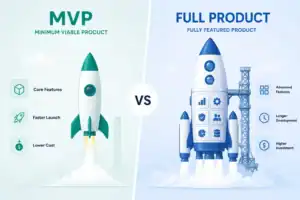
| MVP | Full Product |
|---|
| Core functionality only | Complete feature set |
| Lower investment | Higher investment |
| Faster launch | Longer development cycle |
| Early market validation | Mature product with advanced features |
| Frequent iterations | Stable long-term releases |
For startups, the ability to validate an idea quickly often creates a bigger competitive advantage than launching with dozens of features.
Key Benefits of MVP App Development
Successful startups rarely begin with a feature-rich application. They begin by validating a single idea, learning from users, and expanding strategically. MVP development makes this possible.
Faster Time to Market
Launching an MVP allows startups to reach early adopters weeks or even months earlier than traditional development approaches. Early market entry helps businesses gather feedback while competitors are still building.
Lower Development Costs
Instead of investing heavily in features that users may never use, startups focus their budget on solving one core problem. This reduces initial investment while creating opportunities for smarter future development.
Reduced Business Risk
Every new product carries uncertainty. MVP development minimizes that uncertainty by validating customer demand before scaling the application.
Better User Feedback
Real users provide insights that no amount of brainstorming can replace. Analytics, interviews, and user behavior help startups understand which features create value and which should be removed.
Increased Investor Confidence
Investors prefer evidence over assumptions. A working MVP with active users demonstrates product-market fit and significantly strengthens fundraising conversations.
A Strong Foundation for Future Growth
Modern MVPs are built with scalability in mind. Once the core concept is validated, startups can confidently expand features, integrations, and infrastructure without rebuilding the product from scratch.
For founders, MVP development is not about launching with less. It is about learning faster, spending smarter, and growing with confidence.
SaaS MVP Development: A Category That Demands Speed
SaaS is the most competitive MVP category — and the most rewarding if you get it right. A SaaS MVP is unique because your product IS the service. There is no physical inventory, no logistics buffer. If your onboarding is confusing or your core workflow is clunky, users churn in 24 hours.
Here is what a lean, well-built SaaS MVP typically includes at launch:
- Auth and User Management — Secure login, roles, and permissions.
- Core Workflow (1-2 features) — The primary action your user came to do, done exceptionally well.
- Basic Dashboard — Show users their data and progress.
- Payment Integration — Razorpay or Stripe from day one. Paying users are the only true validation signal.
- Email Notifications — Transactional emails for activation, onboarding, and retention.
- Analytics and Event Tracking — Mixpanel or PostHog to understand where users drop off.
What is NOT on that list: advanced integrations, AI features, enterprise SSO, custom reporting, multi-tenant white-labelling. Those are v2, v3, and v4 problems. Ship the essentials first.
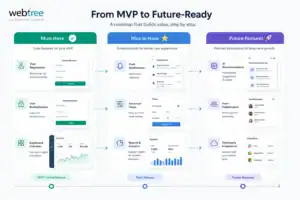
A practical way to prioritize features is the Must Have, Nice to Have, and Future Release framework.
| Must Have | Nice to Have | Future Release |
|---|
| User Login & Authentication | Push Notifications | AI Features |
| User Profile | Social Sharing | Advanced Reporting |
| Core Business Functionality | Third-Party Integrations | White Label Support |
| Analytics Tracking | User Preferences | Enterprise Modules |
| Admin Dashboard | Basic Automation | Multi-Tenant Architecture |
Every feature should answer one question:
Does this help users achieve the primary goal of the product?
If the answer is no, it belongs in a future release.
Keeping the first version lean allows startups to launch faster, gather real-world feedback, and invest future development efforts where they create the greatest business impact.
📚 Also Read
Building a successful MVP requires the right strategy, technology, and execution. Continue exploring these resources to reduce development risks and make smarter software investment decisions.
Common MVP Mistakes That Delay Startup Growth
Building an MVP is about validating ideas quickly, but many startups unintentionally turn their MVP into a full product before testing market demand.
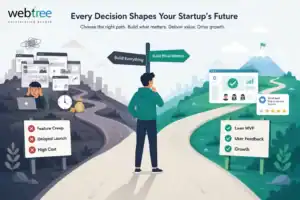
Avoid these common mistakes to maximize the value of your first release.
| Common Mistakes | Better Approach |
|---|
| Building too many features | Focus on solving one problem exceptionally well |
| Skipping customer research | Validate ideas through interviews and market analysis |
| Waiting for perfection | Launch early and improve through iterations |
| Ignoring analytics | Track user behavior and engagement from day one |
| Choosing technology based on trends | Select a scalable stack aligned with business goals |
Remember that every additional feature increases development time, cost, and complexity.
The startups that grow the fastest are often the ones that launch quickly, learn continuously, and improve based on user behavior rather than internal assumptions.
Why India Is the Best Place to Build an MVP
Indian founders have a structural advantage that the Silicon Valley ecosystem would envy — world-class engineering talent at a fraction of the global cost, combined with one of the world’s fastest-growing digital consumer markets.
- 140M+ digital-first consumers in India
- 60-70% cost advantage compared to US/UK agencies
- 50,000 Crore+ VC deployed in Indian startups in 2024
Build In-House vs. Hire an MVP Development Company in India
This is the most debated question among early-stage Indian founders. Here is a straightforward comparison:
| In-House Development | MVP Development Company |
|---|
| Time to Launch | 4–12 months | 6–10 weeks |
| Upfront Cost | Rs. 30–80 Lakhs (salaries, recruitment, and training) | Fixed project cost |
| Tech Expertise | Depends on the quality and experience of hires | Full-stack team available from day one |
| Flexibility | Harder to pivot when requirements change | Built for rapid iteration and refinement |
| Investor Readiness | Variable depending on execution quality | Demo-ready and pitch-ready deliverables |
| Post-Launch Support | Depends on team retention and availability | Ongoing partnership, maintenance, and enhancements |
For pre-revenue founders and early-stage startups, partnering with a dedicated MVP development company in India almost always wins on speed, cost-efficiency, and strategic guidance. You are not just buying development hours — you are buying a launch.
How to Choose the Right MVP Development Partner
Choosing the right development partner can significantly influence how quickly your startup reaches the market and adapts to customer feedback.
Beyond technical expertise, look for a team that understands product strategy and startup growth.

Use this checklist when evaluating an MVP development company:
✅ Experience building startup products
✅ Agile development methodology
✅ Product discovery and consulting services
✅ Scalable architecture planning
✅ UI/UX design expertise
✅ Transparent communication and reporting
✅ Post-launch maintenance and support
✅ Ability to evolve the MVP into a full-scale product
The best development partner does more than write code. They help validate ideas, prioritize features, reduce technical risk, and build a product that can scale as your business grows.
Working with an experienced MVP development company also gives founders access to product strategists, designers, developers, and QA specialists without the cost of building a large in-house team.
Why Startups Choose Webtree
Building a successful MVP requires more than just development expertise. It demands strategic thinking, rapid execution, and a technology partner who understands the challenges of early-stage startups. At Webtree, we work closely with founders to transform ideas into scalable digital products through a collaborative, agile, and business-first approach.
- Business-First Approach: We focus on solving business problems, not just building features.
- Agile Development: Rapid sprints, continuous feedback, and faster time to market.
- Product Consulting: Strategic guidance on feature prioritization, technology selection, and roadmap planning.
- Scalable Architecture: Build a strong technical foundation that grows with your startup.
- End-to-End Support: From product discovery and design to development, launch, and ongoing enhancements.
- Transparent Collaboration: Regular updates, demo sessions, and complete visibility throughout the project.
The Webtree MVP Development Process
At Webtree Software Solutions, we follow a 4-phase Minimum Viable Product development process built specifically for Indian founders and global startups.
Phase 1: Discovery and Product Strategy (Week 1)
We run a focused product workshop to map your user journey, define your ICP, identify your riskiest assumption, and produce a lean product spec. You leave with a clear roadmap — not just wireframes.
Phase 2: Design and Architecture (Week 2-3)
Our UI/UX team builds clean, conversion-focused designs while our architects design a scalable tech stack using React/Next.js, Node.js, and cloud-native infrastructure.
Phase 3: Development and QA Sprints (Week 3-7)
Two-week agile sprints with daily standups, weekly demos, and continuous QA. You see real progress every week — not a black box for 3 months.
Phase 4: Launch and Growth Iteration (Week 8+)
We deploy to production, set up your analytics, and hand over full source code. Post-launch, we stay on as your growth engineering partner — ready to iterate based on real user data.
Ready to Build Your MVP?
Stop overthinking. Start building. Webtree Software Solutions has helped 50+ Indian startups launch investor-ready MVPs. Your idea deserves the same.
Free MVP Strategy Consultation available — Book yours now.
FAQ: MVP Development in India
How much does MVP development cost in India?
MVP development with a professional team in India typically ranges from Rs. 5-20 Lakhs depending on complexity. This is 60-70% less than comparable work in the US or UK, with no compromise on quality.
How long does it take to build an MVP?
A well-scoped MVP takes 6-10 weeks with a focused team. Beware of agencies promising 2-3 weeks — they are either cutting corners or do not understand what an MVP requires.
What tech stack is best for a SaaS MVP?
For most SaaS MVPs, we recommend React/Next.js (frontend), Node.js or Python FastAPI (backend), PostgreSQL (database), and AWS or Vercel (cloud).
Can an MVP be built without a large budget?
Yes. An MVP is designed to validate a business idea with minimal investment by focusing only on essential features. Startups can further reduce costs by prioritizing core functionality, using cross-platform technologies, and adopting an agile development approach. The goal is to test market demand before investing in a full-scale product.
How do investors evaluate an MVP?
Investors look beyond the product itself and focus on evidence of market validation. They evaluate metrics such as user growth, customer engagement, retention rates, conversion rates, and feedback from early adopters. A well-executed MVP demonstrates that the startup understands its target market and has the potential to scale.
Should startups choose native or cross-platform development?
The right choice depends on business goals, budget, and timeline. Cross-platform development is ideal for most startups because it enables faster launches and lower development costs using a single codebase for both iOS and Android. Native development is a better option for applications that require high-performance graphics, advanced hardware integration, or platform-specific experiences.
How long should startups test an MVP?
Most startups should test an MVP for 8 to 12 weeks before making major product decisions. This period allows enough time to collect user feedback, analyze engagement patterns, and identify opportunities for improvement. Instead of adding new features immediately, founders should use real data to decide whether to iterate, pivot, or scale.
Can an MVP evolve into a full SaaS platform?
Absolutely. A well-planned MVP serves as the foundation for a scalable SaaS product. Once the core concept is validated, startups can gradually introduce advanced features, integrations, automation, analytics, and enterprise capabilities based on customer needs and business priorities.
What metrics indicate product-market fit?
There is no single metric that defines product-market fit, but startups should monitor a combination of indicators, including:
- Customer retention and churn
- Daily or monthly active users (DAU/MAU)
- Conversion from free to paid users
- Customer acquisition cost (CAC) and lifetime value (LTV)
Consistent user engagement, positive feedback, and growing demand are strong signals that the product is solving a real problem and is ready for the next stage of growth.
FAQs About Working with Webtree
Will I own the code?
Yes, 100%. At Webtree, you own all intellectual property, source code, and infrastructure from day one. No vendor lock-in, no strings attached.
Do you work with non-technical founders?
Absolutely. Most of our clients are non-technical founders. We translate your business vision into technical execution and communicate clearly at every step. No jargon.