A new player is quietly reshaping how AI tools source information—and it’s making researchers uneasy.
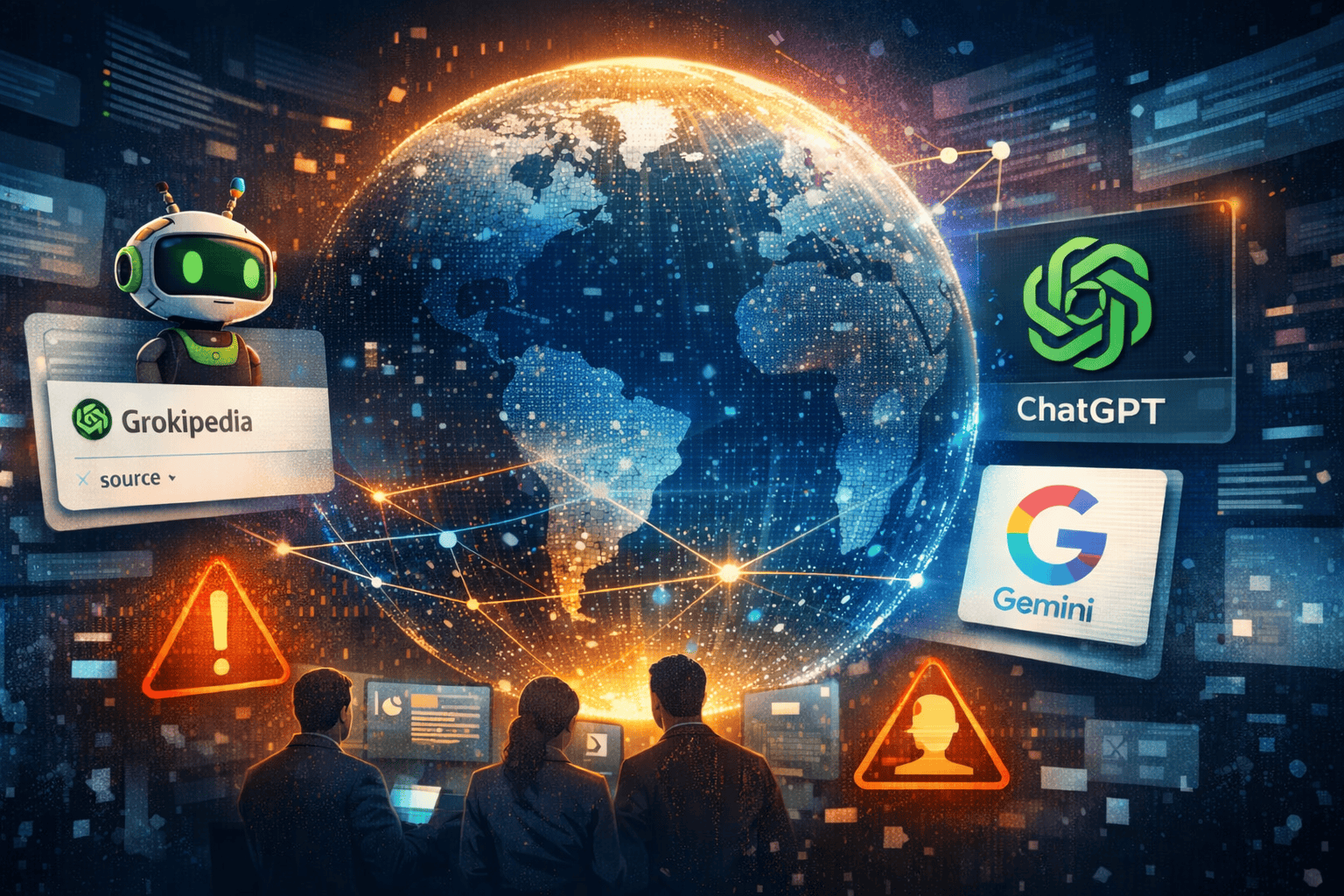
Grokipedia, an AI-generated encyclopedia built by Elon Musk’s xAI, is increasingly appearing as a cited source across major AI platforms, including ChatGPT, Google Gemini, AI Overviews, Microsoft Copilot, and AI Mode. While still much smaller than Wikipedia, its unusually fast adoption inside AI-generated responses has sparked serious concerns about misinformation, bias, and content reliability.
Grokipedia vs Wikipedia: A Fast but Risky Climb
Launched in late October, Grokipedia is entirely generated and edited by xAI’s chatbot Grok, without transparent human editorial oversight. Despite this, analytics firms have observed a sharp rise in how often AI systems reference it.
According to Ahrefs, Grokipedia has already been cited in over 263,000 ChatGPT responses from a dataset of 13.6 million prompts—covering around 95,000 unique pages. By comparison, Wikipedia still dominates with roughly 2.9 million citations, but Grokipedia’s growth rate is notable for such a new platform.
“They’re quite a way off, but it’s still impressive for how new they are,” said Glen Allsopp of Ahrefs.
Which AI Platforms Cite Grokipedia Most?
Not all AI tools rely on Grokipedia equally.
ChatGPT shows the highest usage, often ranking Grokipedia among its top citations
Google Gemini has cited it in ~8,600 responses
Microsoft Copilot around 7,700 times
Google AI Overviews uses it sparingly as a secondary source
Perplexity has cited it only twice
This disparity has drawn attention to how different AI systems evaluate source trustworthiness.
Why Researchers Are Concerned
Unlike Wikipedia, Grokipedia lacks community moderation and editorial checks. Early reviews flagged several issues:
Content closely copied from Wikipedia
Articles containing racist, transphobic, or misleading claims
Entries that downplay Elon Musk’s family wealth
Historical inaccuracies and ideological bias
Experts warn that because Grokipedia itself is AI-generated, it is highly susceptible to LLM grooming—a feedback loop where AI systems repeatedly train on each other’s flawed outputs, amplifying errors at scale.
How AI Companies Are Responding
OpenAI stated that ChatGPT draws from a broad range of public sources and provides citations so users can judge reliability themselves. Google and xAI have not yet commented publicly, while Anthropic declined to respond. Perplexity reaffirmed its focus on source quality and factual accuracy.
Why This Matters for Businesses and SEO
As AI tools increasingly shape how users discover information, being cited by AI systems is becoming as important as ranking on Google. However, this shift also highlights the need for trusted, human-reviewed, high-quality content—not AI-generated echo chambers.
Want Your Brand to Rank Inside ChatGPT, Gemini & Grok?
At Webtree Software Solutions, we help businesses rank, get cited, and drive traffic from AI platforms—not just traditional search engines.
Our AI-focused SEO strategy is designed to:
Improve visibility inside ChatGPT, Gemini, Grok, and AI Overviews
Build authoritative, trustworthy content that AI systems prefer
Drive qualified traffic and real business growth
👉 Book a 7-minute consultancy call with Webtree and discover how to future-proof your SEO for the AI-driven web.