Key Highlights
- The right real estate technology partner should understand both your business goals and property industry workflows.
- Industry experience can reduce implementation risks and improve software adoption.
- Technical capabilities, integrations, security, scalability, and cloud expertise are important when evaluating a technology partner.
- A reliable development process should include discovery, testing, deployment, training, documentation, and ongoing support.
- The lowest development quote may not offer the best long term value.
- The ideal real estate software partner should support your business beyond the initial launch.
Technology has become central to how real estate businesses attract leads, manage properties, close deals, communicate with customers, and monitor operations. From property portals and CRM platforms to ERP systems, mobile applications, automation, and AI, the right technology can make everyday processes faster and easier to manage.
But building or upgrading real estate technology is not simply about hiring a team that can write code.
The partner you choose can influence the success of your digital transformation, the adoption of your software, future development costs, and your ability to scale. A technically capable team may still struggle if it does not understand property workflows or your business objectives.
That is why choosing the right real estate technology partner should be treated as a strategic business decision, not just a vendor selection exercise.
Why Your Technology Partner Matters More Than Your Software
A software vendor may deliver the product you requested. A technology partner should go further by understanding why you need it and how it fits into your wider business.
For example, a real estate company may ask for a CRM. But the actual requirement could involve lead capture from multiple channels, automated follow ups, property matching, agent assignment, customer communication, reporting, and integration with existing systems.
A technology partner looks at the complete workflow rather than only the requested feature.
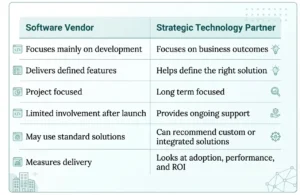
Choosing the wrong partner can result in missed deadlines, poor user adoption, integration problems, security issues, expensive redevelopment, and technical debt.
Real estate digital transformation is also not a one-time project. Your requirements can change as your portfolio grows, new regulations emerge, customer expectations shift, and new technologies become available. Your partner should therefore be capable of supporting that journey.
Start by Defining Your Business Goals
Before approaching a real estate software development company, define what you want technology to accomplish.
 Starting with features can make the selection process unnecessarily complicated. Instead, begin with the business problem.
Ask questions such as:
- Are you trying to improve lead management?
- Do you need a CRM for sales teams?
- Is your ERP limiting operational efficiency?
- Do you need a property management platform?
- Are you planning a property marketplace?
- Do customers need a self service portal?
- Would a mobile app improve customer or employee engagement?
- Can automation reduce repetitive administrative work?
- Could AI improve property recommendations, customer service, or reporting?
Then identify measurable objectives.
For example, instead of saying “we need a better CRM,” define the desired outcome as “reduce lead response time and improve lead conversion.”
Consider creating a simple business goals worksheet covering:
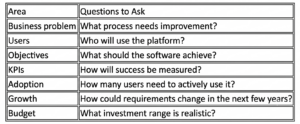
When your objectives are clear, it becomes much easier to identify the right partner and compare proposals.
Evaluate Their Real Estate Industry Experience
Technical expertise matters, but industry knowledge can make a major difference.
A partner that has worked with real estate developers, brokers, property managers, construction companies, or related businesses is more likely to understand the workflows your software needs to support.
Real estate technology can involve several interconnected processes, including:
- Lead generation and qualification
- Sales pipeline management
- Property inventory
- Property booking
- Customer relationship management
- Leasing
- Tenant management
- Maintenance requests
- Agent management
- Commission tracking
- Payments
- Property marketing
- Reporting and analytics
A general software company may be able to develop these functions. However, a partner with relevant industry experience is more likely to identify common challenges before they become expensive development problems.
Ask potential partners about projects they have completed for businesses similar to yours. More importantly, ask what business problem those projects solved.
Assess Their Technical Capabilities
Your technology partner should have the technical capabilities needed for both your current project and future requirements.

Depending on your business, this could include:
- CRM development
- ERP development
- Mobile application development
- Web platforms
- Property portals
- Custom dashboards
- AI solutions
- Cloud technologies
- API development
- Automation
Integration capability is equally important.
Your real estate technology ecosystem may include CRM and ERP platforms, listing portals, maps, payment gateways, accounting software, WhatsApp, email, SMS, analytics tools, and IoT devices.
A new platform should not create another isolated data system.
Ask potential partners how they approach APIs, data synchronization, authentication, third party integrations, and system reliability.
Technical Capability Evaluation Checklist
| Capability | What to Evaluate |
|---|
| Architecture | Is the solution designed for future growth? |
| Cloud | Can the platform use reliable cloud infrastructure? |
| APIs | Can it connect with existing and future systems? |
| Security | Are appropriate security practices built into development? |
| Mobile | Can the partner support iOS and Android requirements? |
| Data | How will information be stored, transferred, and protected? |
| Scalability | Can the system handle more users and transactions? |
| Analytics | Can the platform provide useful business insights? |
Security should not be treated as an afterthought. Ask how the partner handles authentication, access controls, data protection, backups, monitoring, updates, and security testing.
Build Real Estate Software That Grows With Your Business
From CRM and ERP to mobile apps and AI powered property platforms, Webtree develops secure, scalable solutions tailored to your workflows.
Review Their Portfolio and Case Studies
A portfolio can tell you whether a technology partner has experience delivering real projects, but do not stop at logos and screenshots.
Look for projects that demonstrate:
- Similar industry experience
- Comparable technical complexity
- Real business challenges
- Before and after improvements
- Integration capabilities
- Long term support
- Client testimonials
- Live products where possible
Instead of asking only, “Who are your clients?” ask:
“What measurable business outcomes did you deliver?”
For example, a strong case study should explain how a solution helped improve operational efficiency, automate a process, increase customer engagement, simplify property management, or support business growth.
This gives you a better idea of what the partner can actually deliver.
It is also worth speaking with references when possible. Ask previous clients about communication, project management, responsiveness, technical quality, and support after launch.
Also Read: Digital Transformation in Real Estate: A Practical Roadmap for Developers, Brokers, and Property Managers
Understand Their Development Process
A reliable real estate software partner should have a clearly defined development process.
 The process may include:
- Discovery and consultation
- Requirement gathering
- Business and technical analysis
- UI/UX design
- Development
- Agile sprints
- Sprint demonstrations
- Testing and quality assurance
- Deployment
- User training
- Documentation
- Post launch support
Ask how requirements are documented and approved. Find out how changes are handled once development begins.
You should also understand project milestones, delivery timelines, testing responsibilities, communication schedules, and approval processes.
A mature process reduces uncertainty. It also gives you visibility into what is being built and why.
Evaluate Communication and Collaboration
Communication is often overlooked when businesses compare technology partners.
Yet even a technically excellent team can create problems if communication is poor.
Before signing a contract, understand:
- Who will manage your project?
- How frequently will you receive updates?
- Will you have a dedicated project manager?
- Which communication channels will be used?
- How quickly are technical issues addressed?
- How are change requests handled?
- Where will project documentation be maintained?
- How are important decisions recorded?
Weekly project updates, sprint demonstrations, issue tracking, and clear documentation can make collaboration much easier.
You should also know who has decision making authority on both sides. Clear responsibilities prevent delays when approvals or changes are required.
Don’t Ignore Post Launch Support
Launching your software is not the end of the project.
Real estate platforms require ongoing maintenance as businesses grow and technology changes. Users may request new features, integrations may need updates, and security vulnerabilities may emerge.
Your technology partner should have a clear post launch support model covering areas such as:
- Bug fixes
- Maintenance
- Security patches
- Performance optimization
- Feature enhancements
- Cloud monitoring
- System scaling
- Backup management
- User training
- Knowledge transfer
Ask whether support is included in the project cost or offered through a separate agreement.
You should also understand the service level agreement, response times, escalation process, and responsibilities of both parties.
A partner that remains available after launch can help you continuously improve the platform instead of forcing you to start from scratch whenever a new requirement appears.
Cost vs Value: Don’t Choose Based on Price Alone
Price will naturally influence your decision, but the cheapest proposal is not always the most economical choice.

A lower initial quote can sometimes result in higher costs later because of poor development quality, limited scalability, missing features, security problems, or difficult maintenance.
Consider the Total Cost of Ownership (TCO) rather than only the initial development price.
| Lower Cost Vendor | Strategic Technology Partner |
|---|
| Focuses on initial price | Focuses on long-term value |
| May deliver minimum requirements | Plans for future requirements |
| Potential technical debt | Focuses on maintainable architecture |
| Limited scalability | Designed for growth |
| May have additional maintenance costs | Clear support model |
| Feature delivery focused | Business outcome focused |
Ask what is included in the proposal and what is not.
Clarify hosting, integrations, third party services, maintenance, support, licensing, upgrades, security, training, and future enhancements.
The right question is not “Who is cheapest?”
It is “Which partner can deliver the strongest long term business value for our investment?”
Questions Every Real Estate Business Should Ask Before Hiring a Technology Partner
Before selecting a partner, use a practical checklist to compare your options.
Have you built similar real estate platforms?
Ask for relevant examples rather than generic software projects.
Can you integrate with our existing software?
The partner should be able to explain how your existing CRM, ERP, accounting, marketing, payment, or property systems can connect with the new platform.
Who owns the source code?
Make ownership, licensing, intellectual property, and access rights clear before development begins.
What happens after launch?
Understand the support, maintenance, training, and enhancement options available.
How do you handle scalability?
Ask how the architecture can support increasing users, properties, transactions, locations, and data.
Can you support future AI features?
Even if AI is not part of the first release, your architecture should not prevent future AI integration.
What security practices do you follow?
Ask about access controls, authentication, data protection, backups, testing, monitoring, and security updates.
How do you manage project communication?
Clarify meetings, reporting, project management, issue tracking, and escalation procedures.
These questions can help separate a development vendor from a technology partner that is prepared to work with your business for the long term.
How to Make the Final Decision
Once you have evaluated several potential partners, avoid making the decision based on one factor.
Create a simple scoring system based on the areas that matter most to your business.
For example:
- Real estate industry experience
- Technical capabilities
- Integration expertise
- Portfolio and case studies
- Development methodology
- Communication
- Security
- Scalability
- Post launch support
- Total cost of ownership
You can assign each category a score and compare shortlisted partners objectively.
Also consider how comfortable your team feels communicating with the potential partner. A long term technology relationship requires transparency, responsiveness, and mutual understanding.
The best partner is not necessarily the biggest company or the one offering the lowest quote. It is the one that understands your business, can deliver the required technology, communicates clearly, and has the capability to support your growth.
Conclusion
Choosing the right real estate technology partner can have a lasting impact on your business.
The right partner does more than develop software. They help translate business objectives into practical technology, connect existing systems, plan for future growth, and support your platform after launch.
Start by defining your goals. Then evaluate industry experience, technical capabilities, portfolio quality, development processes, communication, security, scalability, and support.
Most importantly, look beyond the initial development cost.
Real estate technology is a long term investment. A partner that understands your industry and your growth objectives can help you build technology that continues to deliver value as your business evolves.
FAQs
1. What should I look for in a real estate technology partner?
Evaluate their real estate industry experience, technical expertise, integration capabilities, development process, communication, post launch support, security practices, and ability to deliver scalable solutions aligned with your business goals.
2. Should I choose a real estate specialist or a general software company?
A technology partner with real estate experience typically understands property workflows, CRM processes, inventory management, sales cycles, leasing, and other industry specific requirements. This can reduce implementation risks and improve the relevance of the final solution.
3. How important is post launch support for real estate software?
Post launch support is essential for bug fixes, security updates, performance optimization, feature enhancements, integrations, and scaling. A clear support model can also help your business adapt the platform as requirements change.
4. Can a technology partner integrate new software with my existing systems?
Yes. An experienced partner should be able to integrate systems such as CRM, ERP, accounting software, payment gateways, marketing tools, property portals, communication platforms, and other third party APIs where technically and commercially feasible.
5. How do I know if a technology partner can scale with my business?
Review their experience with scalable platforms, cloud technologies, architecture, API development, database design, security, and ongoing support. Their portfolio can also show whether they have supported businesses as they have grown.
6. Why is choosing the cheapest technology partner often a mistake?
A low initial price can sometimes result in poor quality code, limited scalability, insufficient security, technical debt, and higher maintenance or redevelopment costs. Compare total cost of ownership and expected business value instead of focusing only on the initial quote.